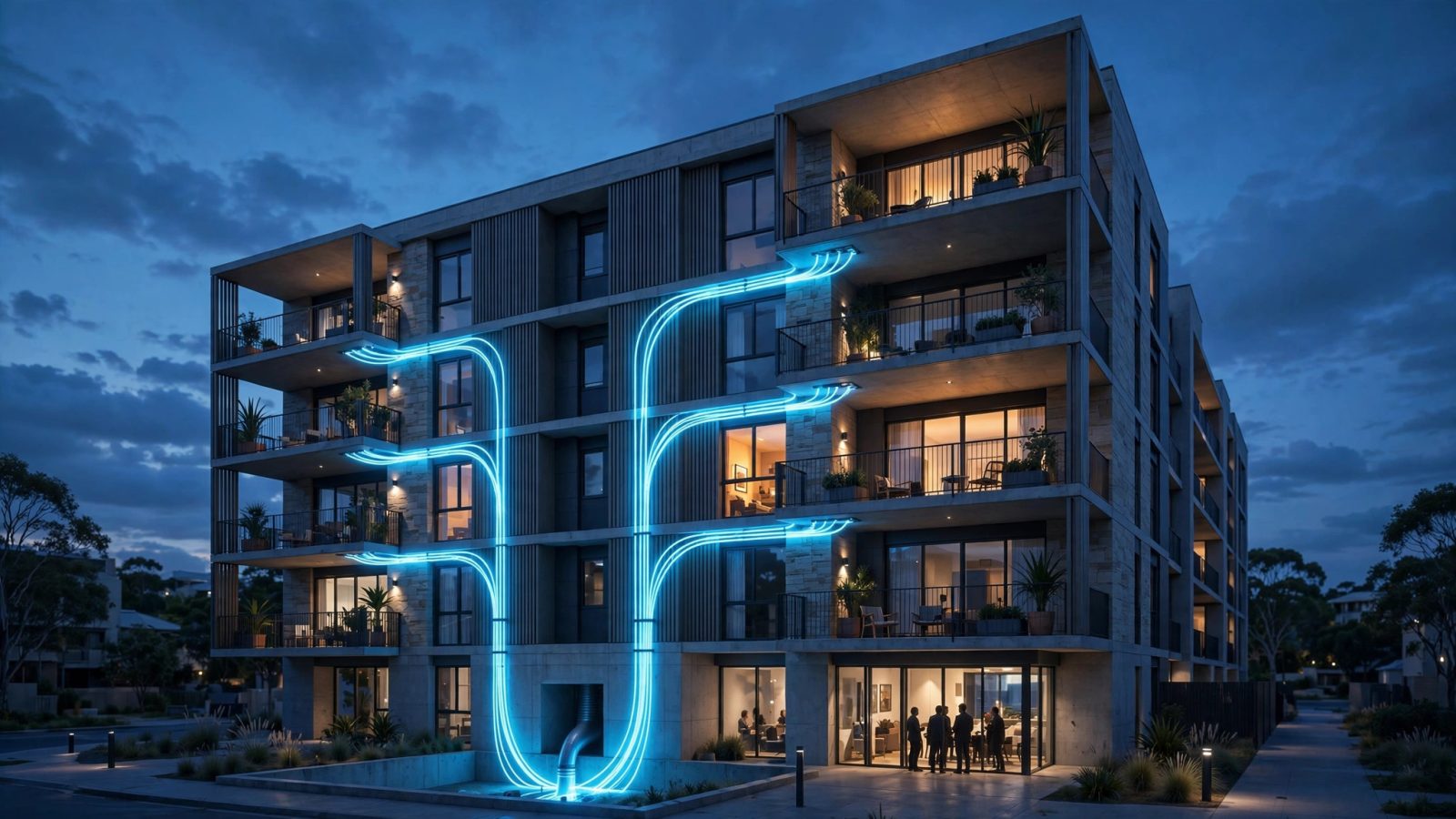
If you live in a house, NBN Co’s fibre upgrade is simple: order a 100 Mbps+ plan and the upgrade is free. If you live in an apartment, none of that applies. Your building upgrades as a whole — through the body corporate, at $275 per apartment — or not at all. And if your building runs on Fibre to the Basement, there may be no upgrade path whatsoever.
In brief
- Renters cannot order a fibre upgrade alone — apartment blocks upgrade as a whole building. How the strata and FTTB upgrade path works, costs included.
- Why apartments are different: In a standalone house, NBN Co deals with one premises and one occupant.
- The strata fibre upgrade: how it works
- Who pays the $275?: There is no single hard-and-fast rule — and that is the honest answer, not a dodge.
- Can a renter order the upgrade alone?
NBN Co’s free fibre upgrade — order a 100 Mbps plan or faster, stay on it for a year, and NBN Co runs fibre to your house at no charge — is one of the best deals in Australian broadband. It is also a deal that apartment dwellers cannot claim on their own. In a strata building, fibre arrives through a different program with different rules: the body corporate signs an agreement, the whole building is upgraded together, and the cost is $275 per apartment including GST. Renters cannot start that process alone. And if your building’s technology is Fibre to the Basement (FTTB), the program may exclude you entirely. Here is how the apartment path actually works, who pays, and what to do when the answer is no.
Why apartments are different
In a standalone house, NBN Co deals with one premises and one occupant. In an apartment building, the fibre has to travel through common property — risers, communications rooms, basements, and walls that no single resident owns. That is why NBN Co does not deal with apartment owners individually. The decision belongs to the building, made collectively through the body corporate (called the Owners Corporation in some states), and the upgrade is a whole-of-building infrastructure project, not a per-flat service order.
NBN Co is targeting buildings where apartments have Fibre to the Node (FTTN) or Fibre to the Curb (FTTC) connections. When the program launched in 2023, NBN Co targeted roughly 50,000 strata buildings nationally, aiming to migrate up to 700,000 apartments to full fibre. That is the scale of the opportunity — and the reason this article exists: hundreds of thousands of apartments are eligible for an upgrade their occupants do not know how to start.
The strata fibre upgrade: how it works
The process, step by step:
- Check eligibility. NBN Co has a search tool to check whether an apartment block is eligible for the strata fibre upgrade. Your building must be on FTTN or FTTC. Check before you lobby anyone — an ineligible building wastes everyone’s time.
- Raise it with the body corporate. The body corporate — through its committee, strata manager, or at a general meeting — must agree to the upgrade: NBN Co says a majority of the body corporate or owners committee must vote in favour. An individual resident, owner or renter, cannot order it alone. If you are a renter, this means convincing your landlord or property manager to raise it, or asking the strata manager directly whether the building has considered it.
- Sign an Area Switch Agreement. NBN Co enters into an Area Switch Agreement with the body corporate for the building. This is the formal contract: fibre delivered to each apartment, at a cost of $275 per apartment including GST (a 10-apartment building costs $2,750). Common area services — security and access control, EV chargers, solar power, video surveillance — are also charged at $275 per connection. For more complex installations — heritage buildings, difficult risers — the fee may be higher and is confirmed before work starts.
- Installation. Once the installation plan is accepted and returned to NBN Co, NBN Co says the infrastructure upgrade typically takes 3–4 months, depending on the complexity of the building. Equipment is installed as close to existing equipment or infrastructure as practical, using existing cable pathways where available. All individual premises in the building get their NBN infrastructure upgraded — this is a whole-of-building job, not a per-flat opt-in. If the building pulls out after receiving the installation plan, NBN Co says a break fee is payable to cover planning, design and preparatory work already done.
- Order a plan. Once fibre is delivered to your door, you contact an internet retailer and sign up for a plan that suits you. There is no obligation to take advantage of the fibre — but there would be little point in the building paying for it otherwise. Unlike the house upgrade, you are not required to order a 100 Mbps+ plan: apartment occupants can order 50 Mbps plans or below and run them on fibre if that suits them.
One detail that surprises people: if an individual owner does not want fibre installed in their apartment, NBN Co installs fibre up to the closest available point outside that premises. The building still upgrades; the reluctant flat just does not get the final run inside.
Who pays the $275?
There is no single hard-and-fast rule — and that is the honest answer, not a dodge. The building decides how to finance the upgrade. Common approaches:
- The owners corporation pays from the capital works (sinking) fund. The upgrade is building infrastructure, like a roof or a lift, so funding it collectively from the fund is the most common path. This spreads the cost across all owners.
- A special levy. The owners corporation raises a one-off levy on owners — $275 per lot — to cover the cost.
- The owner pays individually. In some buildings, owners pay their own $275, particularly where the upgrade is driven by a subset of enthusiastic owners.
Renters do not pay the upgrade cost directly — the fee is charged to the building, and therefore to owners. But renters should be aware that a landlord who pays $275 may see it as a reason the property is more valuable, not as a cost to pass on. There is no mechanism for a body corporate to bill a tenant for the upgrade.
Because the financing decision is a strata decision, not a telecommunications decision, your building may need legal advice to implement the upgrade and create relevant by-laws. If your committee is unsure, that is a legitimate cost to budget for — and it is a better conversation than the one where the building does nothing because nobody knew who pays.
Can a renter order the upgrade alone?
No. A renter cannot order the strata fibre upgrade, and neither can an individual owner. The Area Switch Agreement is signed by the body corporate for the whole building. A renter’s role is to advocate: ask your property manager or landlord to raise it with the body corporate, or contact the strata manager yourself to ask whether the building has considered it. The strongest argument is the building’s: fibre is permanent infrastructure that lifts every apartment’s value and appeal, and the per-apartment cost is modest compared with any other building work.
What a renter can do without anyone’s permission is covered in our companion guide, NBN for Renters: What You Can Get Without Landlord Permission — including 5G home internet, which is often the fastest option available to a renter today, and the FTTC rule change that lets some renters improve their connection without an upgrade.
The FTTB problem: buildings with no upgrade path
Here is the gap that most guides skip. Apartments connected via Fibre to the Basement (FTTB) are not eligible to connect to full fibre straight away under the current program. NBN Co’s current eligibility page lists only FTTN and FTTC buildings, and says FTTB — along with satellite, fixed wireless and HFC — “won’t be eligible to connect to full fibre straight away”, while inviting those buildings to check eligibility and register for updates. FTTB works by running fibre to the building’s basement, then copper from the basement to each apartment. Upgrading it to full fibre means replacing the internal copper in every apartment — a much harder job than the FTTN/FTTC path, where the fibre run is more straightforward.
That matters because FTTB is common in older high-rise buildings. According to the 2021 Census, there are over 370,000 high-rise apartments (nine storeys or higher) in Australia, and many older ones rely on FTTB. FTTB NBN plans max out at 100 Mbps — residents cannot order 250, 750, or 1000 Mbps plans no matter what they pay.
If your building is FTTB, your options are:
- Check eligibility and register for updates. NBN Co’s own advice for FTTB buildings is to check the address tool and register interest, so you are notified if your building becomes eligible.
- Consider 5G home internet. This is the most practical alternative for FTTB apartments: an uncapped 5G plan can deliver speeds well above 100 Mbps with no installation and no body corporate approval. See our 5G vs NBN comparison — but check the CGNAT warning in our 5G and CGNAT guide if you host anything at home.
- Consider NBN Fixed Wireless if your address is eligible — though for most inner-city apartments, 5G is the more available alternative.
What to tell your landlord or property manager
If you are a renter who wants fibre, the conversation with your landlord or property manager is the whole game. A script that works:
- Lead with the building, not your flat. “The building is eligible for NBN Co’s strata fibre upgrade — $275 per apartment, whole building, fibre to every door.” Landlords respond to building value; “my internet is slow” is a personal complaint, “the building can get fibre for $275 a unit” is an investment case.
- Name the process. “The body corporate signs an Area Switch Agreement with NBN Co. Installation takes around 3–4 months once the installation plan is accepted. There’s no obligation to change plans afterwards.”
- Address the cost question before it is asked. “The owners corporation can fund it from the capital works fund or a special levy — it’s a building infrastructure decision, not a per-tenant cost.”
- Bring the eligibility result. Check NBN Co’s eligibility tool for your building first, and bring the result. A concrete “our building is eligible” beats a general “I heard about this program”.
If the body corporate refuses, you still have options: 5G home internet needs no approval, and our NBN for Renters guide covers what you can improve without touching the building’s wiring.
What this means for you
- Apartment fibre upgrades run through the body corporate, not through individual residents. Nobody — owner or renter — can order one alone.
- The program covers FTTN and FTTC buildings: $275 per apartment including GST, whole building, Area Switch Agreement, 3–4 month installation once the plan is accepted, no minimum plan speed afterwards.
- Who pays is the building’s decision: capital works fund, special levy, or individual owners. Renters do not pay directly.
- FTTB buildings are not eligible to connect to full fibre straight away under the current program. Check the eligibility tool and register for updates — and if it does not come, 5G home internet is the practical alternative.
- Renters: your leverage is advocacy. Bring the eligibility result and the building-value case to your landlord or strata manager; the upgrade is infrastructure, not a personal favour.
- Compare providers: once the building is fibre-ready, our best NBN providers 2026 comparison ranks 8 providers on ACCC-verified speeds and real prices.
Sources
- NBN Co — common questions on full fibre upgrades for buildings (primary source)
- WhistleOut — NBN Co Targeted Upgrade program explained

Shoaib Hassan
Shoaib Hassan is the founder and editor of AuTechWire, an independent technology publication covering broadband, mobile networks, privacy, startups, and consumer tech.
Related Stories

Apple’s October 28 Event: The First Touch-Screen MacBook Is Finally Coming
In brief Apple confirmed a second October product event — "Pro and tell," held in Los Angeles on…

Cyberpunk 2077 Update 2.5: Everything in the Edgerunners Patch (and What Leaked Early)
In brief CD Projekt Red announced Update 2.5 on October 20, 2026: it goes live October 22 for…

GTA 6 Pre-Orders Hit 6.45 Million — $630 Million Before Launch
One month before launch, Grand Theft Auto VI has already pre-sold an estimated 6.45 million copies — roughly…