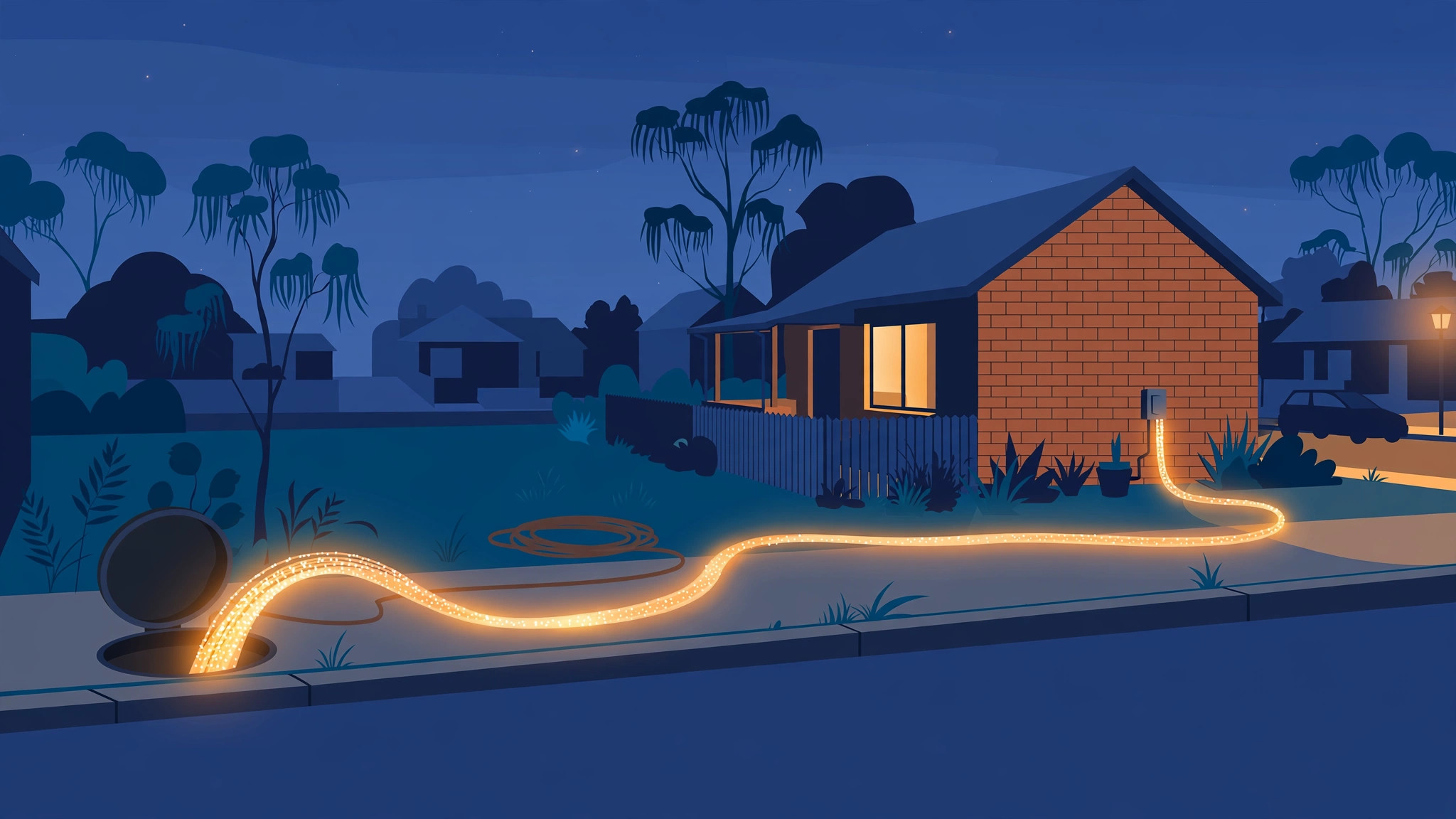
If your internet still arrives over the old copper phone line, you are now in the minority. More Australian homes and businesses run on full fibre than on copper for the first time, and NBN Co says around 47,000 premises a month have been making the switch since October 2025. The upgrade itself costs nothing. The catch, if there is one, is knowing which of two pathways applies to your address, and what your provider will ask of you along the way.
In brief
- Still on copper NBN? You may qualify for a free FTTP fibre upgrade. Here is how to check your address, what is free, how long install day takes, and who pays for what.
- More than a million homes have already upgraded, and around 47,000 premises a month have been switching since October 2025.
- FTTP runs fibre all the way into your home. No copper anywhere in the path, so faster speeds, a steadier connection, and far less trouble from weather and line faults.
- Whether you can upgrade depends on the technology serving your address now: FTTN, FTTC, FTTB, HFC, or FTTP already.
- Two routes exist. Fibre Connect is the voluntary one you request through your provider. Targeted Upgrade, from 2027, is managed by NBN Co and is not optional.
Copper is on the way out
For the first time in the network’s history, there are more Australian homes and businesses on full fibre connections than on legacy copper-based services.
Full fibre, Fibre to the Premises or FTTP, runs a fibre-optic line all the way into your home, with no copper in the path at all. That means faster speeds, a more stable connection, and far less sensitivity to weather and line faults than the older Fibre to the Node (FTTN) and Fibre to the Curb (FTTC) technologies, which still rely on copper for the final stretch to your door.
Best of all, the upgrade itself is free. NBN Co funds the fibre build to your home. What you need to know is which pathway applies to your address, whether your plan needs to change, and what to expect when the technician arrives.
What changes when the copper goes
On FTTN, fibre runs to a cabinet in your street and copper phone line carries the signal the rest of the way. The longer that copper run, the slower and less reliable your connection. On FTTC, the fibre gets closer, to a pit near your curb, but copper still covers the last leg.
FTTP removes copper entirely. The result is a connection that can deliver the fastest residential speeds NBN Co sells, up to close to 1 Gbps on its top wholesale tier, with lower latency and far more headroom for households running many devices at once. It is also far more resilient in storms, floods and fires, because fibre does not conduct electricity and does not degrade the way copper does in wet conditions.
Fibre is not magic, though. Your real-world speed still depends on the plan you buy, your router, and whether your devices connect over Wi-Fi or Ethernet. Upgrading the line without upgrading an old router is the most common reason people see little improvement. Worth remembering before you book.
Can your address get it?
Eligibility depends on the technology currently serving your address:
- FTTN (Fibre to the Node): Eligible in most areas where fibre has been rolled out to your street. You order the upgrade through your internet provider.
- FTTC (Fibre to the Curb): Eligible across the 860,000-premises FTTC footprint. Since 1 July 2026, you no longer need to order a high-speed plan to qualify.
- FTTB (Fibre to the Basement): Typically apartments and office buildings. Individual upgrades are not offered the same way; buildings are handled through NBN Co’s program for multi-dwelling properties, which requires the body corporate or building owner to register interest. See our guide to NBN FTTP upgrades for apartments and renters for the full strata process, the $275 fee, and what to do if your building says no.
- HFC (Hybrid Fibre Coaxial): Not part of the fibre upgrade program. HFC already uses fibre to near your home and has received its own speed upgrades.
- Already on FTTP: You are done. Your only decision is which speed tier to buy.
The fastest way to check is NBN Co’s address checker on the nbn website. Enter your address and it will tell you your current technology and whether an FTTP upgrade is available. Your provider can also confirm it, since they hold your address record.
Two routes to fibre
There are now two pathways to full fibre, and which one applies depends on where you live.
1. Fibre Connect, the one you ask for
Fibre Connect is the main program and the one most households will use. You request the upgrade through your internet provider, NBN Co schedules the build, and a technician installs the fibre to your home. More than one million upgrades have already been delivered this way.
For FTTC premises, the rules changed on 1 July 2026: you can now request the upgrade on whatever speed plan suits you. Previously you had to order a plan of at least 100/40 Mbps to qualify. That barrier is gone.
For FTTN premises, most providers still require you to order a higher-speed plan to trigger the upgrade, typically a 500 Mbps plan, and some apply a minimum term (commonly 12 months) with an early-exit fee if you downgrade sooner. Terms vary by provider, so check before you sign. If you only need a basic plan, the FTTC-style rule relaxation has not yet been extended to FTTN, though NBN Co has signalled a long-term path for the remaining FTTN footprint by the end of 2030.
2. Targeted Upgrade, the one NBN Co chooses for you (from 2027)
Announced in April 2026, the Targeted Upgrade program is NBN Co’s managed transition for a smaller group of premises in areas where fibre is already available. It targets underperforming copper lines and areas where retiring an underused node simplifies the network.
The key differences: you do not need to order a high-speed plan, and the upgrade is not optional. NBN Co aims to notify around 130,000 homes and businesses in the program’s first year, with the first notifications going out from July 2027. If you are selected, you will have a set window to place your upgrade order. The first suspensions of legacy copper services for premises that have not placed an order are not expected until January 2028, and NBN Co says safeguards will include multiple notifications, the option to extend or defer, and case-managed support for customers who need extra help.
If you receive a Targeted Upgrade notification, treat it as a deadline, not marketing. Your copper service will eventually be switched off.
What you will actually pay
The fibre build itself, the cable to your home, the outdoor box, and the indoor connection box, is free under both programs. You do not pay NBN Co for the installation.
What you do pay for is your internet plan, as usual. If your provider requires a higher-speed plan to trigger a voluntary FTTN upgrade, that plan will cost more per month than a basic tier. Some providers also charge for a compatible modem if yours cannot handle the faster speeds, and some apply early-exit fees if you drop below the minimum tier within the contract term. Ask your provider for the full picture, plan price, modem, contract term, and any downgrade fee, before you commit.
For renters, the infrastructure upgrade is handled between NBN Co, your provider and the property. You can request an upgrade, but speak with your provider about the process for your tenancy, and be aware that some landlords or property managers want to be told before installation work begins.
What install day looks like
Once your order is accepted, your provider books an installation appointment, typically within two to four weeks. On the day:
- The technician runs fibre to your home. A thin fibre-optic cable is run from the street pit or pole to your house along the existing telecommunications pathway.
- An outdoor box goes on an external wall. NBN Co installs a small weatherproof utility box (on newer installs, this may be a premises attachment point instead) where the fibre enters your property.
- An indoor connection box is installed. The NBN connection box goes inside your home, near a power point, often in a garage, study or living area. This is the box your router plugs into.
- Your service is cut over. Once the fibre is live, your provider moves your service onto the new connection.
The on-site work typically takes two to four hours, and you will need to be home. One thing to plan for: the indoor connection box needs mains power. Unlike old copper phone lines, FTTP stops working in a power outage unless you have an independent battery backup. If you rely on a landline phone service or a medical alarm, talk to your provider about backup options before the switch.
Why NBN Co is pushing this now
The fibre upgrade is the largest single program in the NBN’s history. It began as an on-demand scheme for homes willing to pay for faster plans, but it has steadily widened: the Federal Government committed $2.4 billion to extend the upgrade to a further 1.5 million FTTN premises, and NBN Co has mapped an upgrade path for the remaining FTTN footprint by the end of 2030, which would give more than 94 per cent of FTTN customers the option of full fibre.
The economics point the same way. Maintaining two parallel networks, fibre and ageing copper, is expensive, and copper fault rates are higher, particularly on the FTTC network. Every home that moves to fibre removes a copper line NBN Co no longer has to maintain, and gives the household a connection that should not need another major upgrade for decades.
For households, the practical question is no longer whether fibre is better. It is whether your address is ready and which pathway gets you there with the least fuss. If you are on FTTC, the answer since 1 July 2026 is straightforward: ask your provider for the upgrade on your current plan. If you are on FTTN, weigh the cost of a higher-speed plan against the benefit, or wait to see whether your address is picked up by the Targeted Upgrade program. Either way, the copper network is on a path to retirement, and the sooner you plan the move, the more control you keep over the timing.
Your next move
- Check your address first. NBN Co’s address checker tells you your current technology and whether FTTP is available. Do this before calling your provider.
- FTTC homes: the barrier is gone. Since 1 July 2026, you can upgrade to full fibre on any speed plan, no high-speed plan required.
- FTTN homes: expect a plan condition. Most providers still require a higher-speed plan (typically 500 Mbps) to trigger a voluntary upgrade, sometimes with a 12-month term. Confirm the terms before ordering.
- Watch for a Targeted Upgrade letter from July 2027. If your address is selected, the upgrade becomes mandatory on a set timetable, with copper disconnection as the last resort.
- Prepare for install day. You will need to be home, the indoor connection box needs a power point, and your old modem may need replacing. Ask your provider about modem compatibility and battery backup if you depend on a landline.
- our complete guide to NBN plans, speeds and upgrades
- NBN for renters: what you can get without permission
Sources
- GadgetGuy — NBN Co lowers the full fibre upgrade barrier for FTTC homes
- WhistleOut — NBN Co Targeted Upgrade program explained
Part of the NBN & Home Internet in Australia guide — the full set of stories on this topic, in one place.
Related Stories

NASA’s Deep Space Network: The Three Antennas Talking to Voyager 1
Voyager 1 is one light-day from Earth, and the Deep Space Network is the only thread holding it.
Read
FAA System Failure Grounded Flights Nationwide: What Broke and What It Means
The FAA stopped every US departure on 13 November 2026 after a new router flooded its legacy network.
Read
Silksong Sea of Sorrow: What Team Cherry’s ‘Cherry Time’ Presentation Could Finally Reveal
Team Cherry's "Cherry Time" airs Friday, November 27, with a Sea of Sorrow update.
Read
Voyager 1 Data Glitch: What’s Wrong and Can NASA Fix It?
What happened: The Voyager 1 data glitch began November 14, days before the probe crossed one light-day from Earth.
Read
VPN for Streaming: Why Blocks Happen and What Actually Fixes Them
How streaming services spot VPN traffic, the fix ladder to work through in order, and the honest limit no provider can promise past.
Read