5G home internet is no longer a stopgap. In 2026 it genuinely competes with the NBN on speed and price for many Australian homes — but it loses on consistency, uploads and control. Here is how the two stack up, and which one suits your household.
If you are shopping for home internet in Australia in 2026, you now have two serious options: a fixed NBN connection, or a 5G home internet plan that runs off the same mobile towers as your phone. Both can deliver 100 Mbps or more to a typical home. Both cost roughly $70 to $100 a month at the popular speed tiers. And both can disappoint you for completely different reasons. The right choice comes down to your address, your household’s habits, and whether you value raw speed or rock-solid consistency.
How the two technologies actually work
The NBN is a fixed-line network. Your home connects to it through fibre, hybrid fibre-coaxial cable, copper, fixed wireless or satellite, depending on your address. Once installed, that connection is yours: the line runs to your premises and nobody else’s usage directly shares your last stretch of cable or fibre.
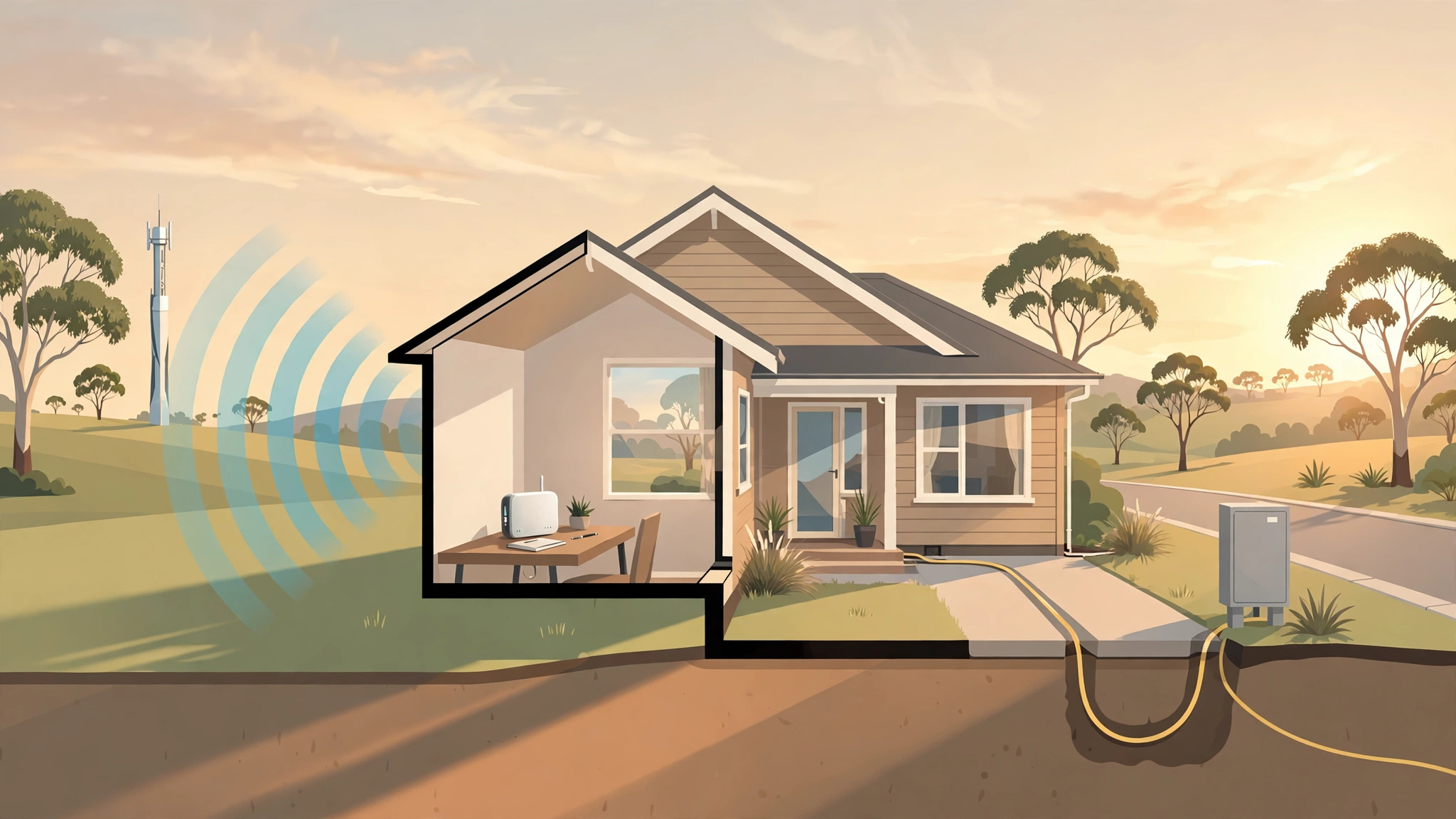
5G home internet is wireless. A modem with a SIM card sits in your home — ideally near a window facing the nearest tower — and connects to a mobile network. There is no technician visit, no wall socket and no installation appointment. You plug the modem in, it finds the 5G signal, and you are online in minutes.
That convenience is 5G’s biggest selling point, and its biggest weakness. A wireless signal is affected by distance to the tower, building materials, weather, trees, and how many other people are using the same tower at the same time. A fixed line is not. That single difference explains almost every trade-off below.
Speed: 5G can be faster on paper, NBN is more predictable
On headline speeds, the top 5G plans compete well. Telstra’s Premium 5G plan delivers a typical evening speed of around 300 Mbps. Optus’s Superfast 5G plan advertises typical evening speeds of roughly 210–230 Mbps. Those figures sit comfortably above an NBN 100 plan, and in the right location with a strong signal, 5G can briefly go faster still.
But “typical evening speed” is doing a lot of work. 5G speeds vary far more than NBN speeds do. The same modem can deliver 250 Mbps at 11 am and 60 Mbps at 8 pm when the local tower is busy. Your result depends on your exact address, which room the modem sits in, and even which way your windows face.
The NBN, by contrast, has become remarkably consistent. The ACCC’s final Measuring Broadband Australia report, covering March 2026, found NBN fixed-line services delivered an average of 100.0% of plan speed across all hours, and 99.4% during busy hours between 7 pm and 11 pm. In other words, an NBN 100 plan now delivers close to 100 Mbps almost all the time. (The ACCC has since ended the Measuring Broadband program, but its final results remain the best independent benchmark available.)
That consistency is why the NBN still wins for households that need their connection to behave the same way every evening: families streaming on several screens at once, people working from home, and anyone who games competitively.
Uploads: the NBN’s clearest win
Download speeds get all the attention, but uploads decide how good your connection feels for video calls, cloud backups, and sending large files. This is where 5G home internet falls behind.
Telstra’s Premium 5G plan offers uploads of around 30 Mbps. TPG’s 5G plans top out at 16–18 Mbps upload. Optus’s capped 5G tiers sit lower again. Those figures are fine for video calls and everyday use, but they lag the NBN: an NBN 100/20 plan offers up to 20 Mbps upload, and NBN 500 plans now offer 50 Mbps upload following NBN Co’s September 2025 wholesale speed upgrades.
If your household regularly uploads video, backs up large photo libraries, livestreams, or runs a home office with heavy cloud use, the NBN’s stronger and more stable uploads are a genuine advantage. If you mostly stream, browse and scroll, 5G’s uploads will rarely bother you.
Price: 5G is cheaper at the entry level, NBN wins at the top
At the popular mid-range tiers, the two are priced almost identically. But the details matter — especially introductory pricing, which can make a plan look far cheaper than it really is.
5G home internet prices (as at 13 October 2026):
| Provider | Plan | Typical speed | Price |
|---|---|---|---|
| Telstra | Basic 5G | 25 Mbps cap | $70/mth |
| Telstra | Essential 5G | 50 Mbps cap | $80/mth |
| Telstra | Premium 5G | ~300 Mbps evening | $95/mth |
| Optus | Everyday 5G | 50 Mbps cap | $69/mth |
| Optus | Everyday Fast 5G | 100 Mbps cap | $79/mth |
| Optus | Superfast 5G | ~210–230 Mbps evening | $99/mth |
| TPG | 5G Plus | 50 Mbps evening | $29.99/mth for 6 months, then $59.99 |
| TPG | 5G Premium | 100 Mbps evening | $39.99/mth for 6 months, then $69.99 |
Telstra’s Premium plan rose from $85 to $95 a month on 1 July 2026. TPG’s prices are the sharpest in the market, but note the step-up after the six-month introductory period — the ongoing price is what you will actually live with.
NBN prices (as at 13 October 2026): NBN 50 plans typically cost from around $70 a month ongoing, and NBN 100 plans average just over $96 a month, with frequent six-month introductory offers dropping the first months to $50–$80. One of the sharpest deals in the market right now is TPG’s NBN 500 plan at $69.99 a month for the first 12 months, then $94.99 — a 500 Mbps fixed-line connection for less than the ongoing price of most top-tier 5G plans.
The pattern is clear: 5G wins on cheap entry-level pricing, especially through TPG. The NBN wins at the top end, where 500 Mbps fixed-line plans now cost about the same as the fastest 5G plans while delivering far more consistent performance.
Data allowances: watch Telstra’s cap
Most 5G home internet plans in Australia now come with unlimited data — Optus, TPG and Vodafone all offer it. Telstra is the exception. Every Telstra 5G home plan includes a 1,000 GB monthly allowance. After that, speeds are shaped down to 1.5 Mbps on the capped tiers, or up to 25 Mbps on Premium, for the rest of the billing cycle.
For most households, 1,000 GB is plenty. But if your home streams 4K on several screens, downloads large games regularly, or backs up terabytes to the cloud, you can chew through it. NBN plans, by contrast, are effectively all unlimited data in 2026. If you are a very heavy user, that alone may settle the question.
Availability: 5G is not available everywhere, and the NBN is not fast everywhere
Coverage is where the comparison gets genuinely address-specific. 5G home internet is only sold in selected areas — mostly metro and larger regional centres — and even inside a coverage area, your exact address matters. Telstra also limits the number of 5G home plans it sells per postcode to keep its towers from congesting, so a neighbour’s eligibility does not guarantee yours.
The NBN, meanwhile, reaches almost every Australian premises — but not every premises can get a fast NBN plan. Homes on fibre to the node, fibre to the curb or fibre to the basement are capped at NBN 100 speeds. The fastest tiers (NBN 250 and above) need a fibre-to-the-premises or newer HFC connection, though NBN Co’s fibre upgrade program continues to expand that footprint.
That is why the two technologies are often complementary rather than interchangeable. If your NBN connection is a slow FTTN line, 5G home internet may be the faster option at your address. If you have FTTP, the NBN will almost always beat 5G on consistency and top speed.
The practical differences nobody mentions in the ads
Setup. 5G wins easily. No technician, no appointment, no drilling. The modem arrives by post and you are online the same day. NBN connections usually need a technician visit or at least a self-install kit, and switching NBN providers can involve a short outage.
Renting and moving. 5G is made for renters. There is no fixed infrastructure to install or permission to seek, and you take the modem with you when you move — as long as your new address has 5G coverage from the same provider. NBN stays with the property.
Home phone and alarms. 5G home internet does not support fixed-line telephony, back-to-base security alarms or medical alert services. If your household relies on any of those, check with the provider before switching — for most homes this is a non-issue, but for some it is a deal-breaker.
Port forwarding and hosting. Most 5G home connections sit behind carrier-grade NAT (CGNAT), which shares one public IP address among many customers. Streaming, browsing and ordinary gaming are unaffected, but port forwarding is effectively off the table. If you host a game server, run a home media server you access remotely, or need inbound connections for work, a fixed NBN connection with a provider that offers a public IP or CGNAT opt-out is the safer choice.
Latency. 5G latency is typically 10–30 ms in good conditions, versus 30–50 ms on 4G. That is fine for most gaming and video calls, but it fluctuates with signal conditions. Fixed-line NBN latency is generally lower and more stable, which competitive gamers will notice.
What this means for you
- Choose 5G home internet if: you rent, you want to be online today with no installation, your NBN connection type is slow (FTTN/FTTC), or you want the cheapest 50–100 Mbps plan on the market — TPG’s 5G pricing is hard to beat.
- Choose the NBN if: you have FTTP or HFC, you need consistent evening speeds, you upload a lot, you work from home, or you need port forwarding, a static IP, or support for alarms and medical alerts.
- Check your address first, always. Run both a 5G coverage check and an NBN address check before deciding. The best connection on paper is useless if your tower is congested or your street is on slow copper.
- Read past the introductory price. Most 5G and NBN deals discount the first 6–12 months. Compare the ongoing monthly price — that is what you will pay for years.
- Use the trial period. Most 5G providers offer a 14- or 30-day trial. Test the modem in the exact spot you will use it, at 8 pm, before you commit.
The bottom line
5G home internet has grown up. For a renter in a strong-signal suburb, or a household stuck on a slow NBN technology type, it is a genuinely good connection — sometimes the best one available at that address. But it has not replaced the NBN. Fixed-line NBN remains the more consistent, more controllable connection, and with 500 Mbps plans now priced around $95 a month, it is the better value at the top end.
The smartest move in 2026 is not to pick a side. Check what your address can actually get, compare the ongoing prices, and choose the connection that fits your household — then re-check in a year, because this market is still moving fast.
Prices and plan details in this article were checked on 13 October 2026 and change frequently. Confirm current pricing, coverage and terms with the provider before signing up.