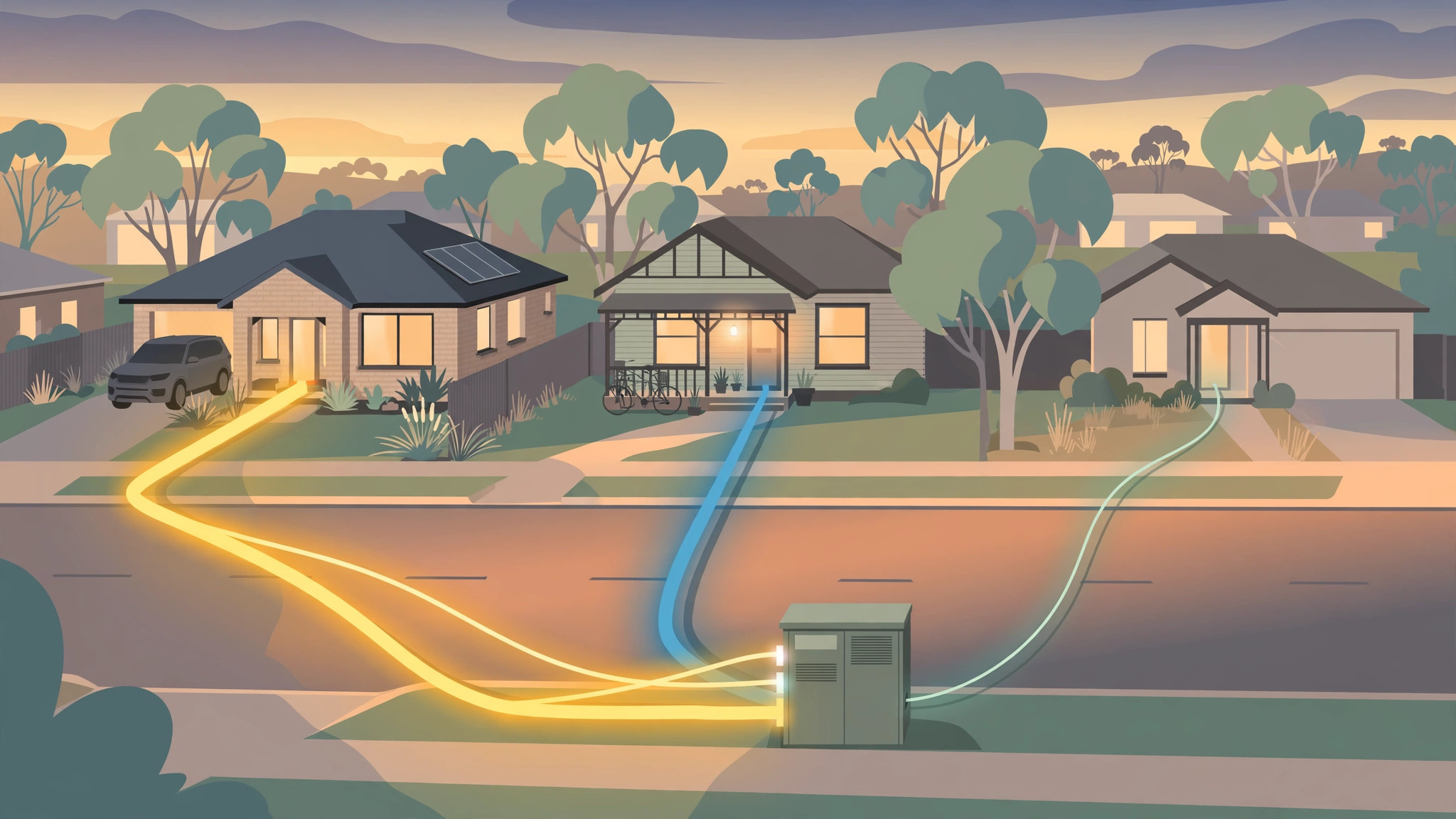
There is no single best NBN provider — there is a best provider for your household, your address and your budget. We compared the major providers on real ACCC-measured speeds, ongoing prices (not the introductory rate), and customer satisfaction to find the standouts, and the traps to avoid.
Every NBN provider sells access to the same network, so why do prices and performance vary so much? Because the network is only half the story. How much capacity a provider buys, how quickly it answers the phone, and how honestly it prices its plans decide whether your evenings are smooth streaming or buffering frustration. In 2026, after a July round of price rises and the wholesale speed upgrades that turned NBN 100 plans into NBN 500 plans on fibre, the gap between the best and worst value has never been wider.
How we judged the best NBN providers
Rankings that rely on one number mislead. A provider can be fast and hated, or loved and slow. So we judged on four things:
- Real speeds: ACCC Measuring Broadband Australia data — independent measurements from real homes, not advertised maximums.
- Ongoing price: the price you pay after the introductory discount ends. Introductory pricing is marketing; the ongoing price is your bill.
- Customer satisfaction: CHOICE’s 2026 Best Brand scores (50% ACCC speed data, 50% satisfaction survey) and Oz Broadband Review’s “would you recommend” results.
- Service basics: Australian-based support, no-lock-in contracts, modem costs, and whether the provider makes switching easy or punishes it.
No provider wins all four. The right pick depends on what you value most.
First: the two things that matter more than the brand
Check your technology before you compare plans. Your address decides what you can buy. Homes on fibre to the premises (FTTP) or HFC can get the fastest tiers, including NBN 500, 1000 and 2000. Homes on fibre to the node (FTTN), curb (FTTC) or basement (FTTB) are effectively capped at NBN 100. Paying for a faster plan than your line can deliver buys nothing. NBN Co’s address checker tells you your technology in a minute. Our guide to NBN FTTP upgrades explains how to get fibre if you are still on copper.
Know the NBN 100 = NBN 500 quirk. After NBN Co’s September 2025 wholesale speed upgrades, most providers now charge the same monthly price for NBN 100 and NBN 500 on FTTP and HFC connections. TPG, Superloop, Telstra, Optus and Dodo all price them identically. If your home can get NBN 500, there is no reason to sit on NBN 100 with the same provider — check whether your plan has already been upgraded, and if not, ask for it. Our guide to NBN speeds explains which tier actually suits your household.
The best NBN providers in 2026
Best overall: Aussie Broadband
Aussie Broadband has topped CHOICE’s Best Brand NBN ranking six years running, and the reason is not speed — it is service. Its customer satisfaction score of 80% is far ahead of every rival (next best is Telstra at 75%), and it is the only provider in CHOICE’s survey to earn very good results for both overall satisfaction and satisfaction with speeds. In Oz Broadband Review’s recommendation survey, 99% of reviewers said they would recommend it.
The trade-off is price and raw speed. Aussie Broadband’s speed score (91%) was the lowest in CHOICE’s 2026 survey, and its plans are not the cheapest: $95 a month for NBN 50 and $99 for NBN 100, with NBN 500 currently promoted at $79 for six months then $99. What you get for the premium is Australian-based support, a reputation for fixing problems rather than deflecting them, and extras gamers value such as live ping tracking and a CGNAT opt-out. If you would rather pay a little more and never fight your provider, this is the pick.
Best for speed: Superloop
Superloop earned the fastest speed score in CHOICE’s 2026 survey (97%), with perfect download speed scores, and shared the Best Brand title with Aussie Broadband at 85%. ACCC data has repeatedly shown Superloop delivering 100% or more of advertised speeds even in busy evening hours. It was also named NBN Provider of the Year in Finder’s Broadband Awards 2026.
Pricing is sharp for the performance: $89 a month for NBN 50 ($69 for the first six months), $95 for NBN 100 ($74 for six months), and — the standout — $95 for NBN 500 ($74 for six months). Its top tiers are equally aggressive: NBN 1000 at $114 ($89 for six months) and NBN 2000 at $168 ($148 for six months). Satisfaction (72%) trails Aussie Broadband, but if speed per dollar is your metric, Superloop is hard to beat.
Best value: TPG
TPG remains the value benchmark among the big brands. NBN 50 costs $89.99 a month ($69.99 for the first six months), while NBN 100 and NBN 500 are both $94.99 — with new customers paying $74.99 for the first 12 months on either. That 12-month deal on NBN 500 is one of the best value plays in the market: 500 Mbps for $74.99 a month for a year.
TPG’s satisfaction score (74%) sits mid-pack, and its support uses a mix of Australian and overseas call centres. It also offers a Price Beat Guarantee on its NBN plans. If you want a fast connection cheaply and are comfortable with less hand-holding, TPG is the rational choice.
Best for big households and bundles: Telstra
Telstra is the most expensive provider in the country, and it knows it. Its internet-only plans run $89 a month for NBN 25, $99 for NBN 50, $99 for NBN 100/500, $119 for NBN 750 and $129 for NBN 1000. Add a modem and those rise to $97, $113, $113, $129 and $139 respectively. So why consider it? Coverage, bundles and support infrastructure. Telstra’s satisfaction score (75%) is second only to Aussie Broadband, its speeds are consistently near plan (94% speed score), and if your household already uses Telstra mobile, bundling can soften the premium. Telstra also offers a 30-day satisfaction guarantee. Pay the premium only if you actually use the bundle or value the brand’s support network.
Best budget: Dodo
Dodo won Finder’s budget NBN provider award for 2026, and the pricing backs it up: NBN 25 at $73.99, NBN 50 at $87.99, NBN 100 at $92.99, NBN 500 at $92.99, NBN 750 at $99.99 and NBN 1000 at $109.99 a month. Those are among the lowest ongoing prices for each tier. Its speed score (96%) is surprisingly strong — equal second with Exetel and iPrimus in CHOICE’s data. The compromise is service: satisfaction sits at 72%, and Dodo’s recommendation rate (63%) is well below the leaders. If the monthly bill is the deciding factor, Dodo delivers the speed for less.
Worth a look: Exetel
Exetel does not appear in every comparison because it flies under the radar, but ACCC data has shown it delivering 100% or more of advertised speeds in peak hours, and its NBN 500 plan has been priced around $80 a month flat — the cheapest high-speed plan tracked by independent comparison sites. Its recommendation rate (79%) beats most big brands. The catch is support, which mixes Australian and overseas call centres. For a fast, cheap connection without frills, Exetel deserves a quote.
Side-by-side: ongoing monthly prices
All prices are the standard ongoing monthly rate in AUD, unlimited data, as at 13 October 2026. Introductory discounts in brackets apply to new customers for the stated period.
| Provider | NBN 50 | NBN 100 | NBN 500 | NBN 1000 |
|---|---|---|---|---|
| Aussie Broadband | $95 | $99 | $99 ($79 first 6 mths) | $129 |
| Superloop | $89 ($69 first 6 mths) | $95 ($74 first 6 mths) | $95 ($74 first 6 mths) | $114 ($89 first 6 mths) |
| TPG | $89.99 ($69.99 first 6 mths) | $94.99 ($74.99 first 12 mths) | $94.99 ($74.99 first 12 mths) | $114.99 |
| Telstra (internet only) | $99 | $99 | $99 | $129 |
| Telstra (with modem) | $113 | $113 | $113 | $139 |
| Optus | ~$97 | ~$99 | ~$99 | ~$129 |
| Dodo | $87.99 | $92.99 | $92.99 | $109.99 |
| Exetel | — | — | ~$80 | — |
Two patterns jump out. First, NBN 100 and NBN 500 cost the same almost everywhere — never pay for NBN 100 if your address qualifies for NBN 500. Second, the spread on NBN 50 is $87.99 to $113, a $25-a-month gap for the same wholesale product. That gap is pure provider margin and service quality.
Speed: what the ACCC data actually says
The ACCC’s Measuring Broadband Australia program — independent test units in real homes — found fixed-line NBN services delivered an average of 100.0% of plan speed across all hours and 99.4% during busy hours in its final report. In other words, the NBN itself now delivers what it sells. The differences between providers are real but small: Superloop, Exetel and Dodo/iPrimus lead on measured speed, while Aussie Broadband trails on raw speed yet wins on satisfaction. That disconnect is the whole story of this market: the fastest provider is not the most loved, and the most loved is not the fastest. Pick the trade-off that matches your household.
Service: satisfaction, support and complaints
Speed is measurable; service is felt. The numbers that matter:
- Satisfaction (CHOICE 2026): Aussie Broadband 80%, Telstra 75%, TPG 74%, iiNet 73%, Dodo/iPrimus/Superloop 72%, Optus 71%.
- Would recommend (Oz Broadband Review): Aussie Broadband 99%, Superloop 90%, Exetel 79%, iiNet 77%, Telstra 75%, TPG 70%, Optus 69%, Dodo 63%.
- Support location: Aussie Broadband and Superloop use Australian-based support. Telstra, Optus, TPG and Exetel mix Australian and overseas call centres.
If you work from home or run a business on your connection, support quality is worth paying for — an afternoon lost to a fault costs more than a year of price differences.
The traps: intro pricing, loyalty tax and modem fees
Introductory pricing is the biggest trap. Most providers discount the first 6–12 months, then revert to the ongoing price. A $69.99 deal that becomes $94.99 is still a good price — but only if you budgeted for $94.99. Always compare the ongoing price, not the headline.
The loyalty tax is real. Finder estimates Australians paid $986 million in loyalty tax on NBN plans in 2025 — the extra paid by customers who stayed on old plans while new customers got better deals. If you have not compared your plan in 12 months, you are probably overpaying. Set a calendar reminder at the end of every introductory period.
Modem fees add up. Telstra’s modem-inclusive plans cost $8–$14 a month more than internet-only. If you leave early, you may owe the remaining modem cost (up to $252 with Telstra). Most providers let you bring your own modem — if yours is a decent Wi-Fi 6 model, do that and skip the fee. Note that buying NBN 1000 and getting 200 Mbps on Wi-Fi usually means the router is the bottleneck, not the connection.
Contracts are mostly gone — read the fine print anyway. Most NBN plans are now no-lock-in, but some introductory deals and FTTP upgrade pathways still carry minimum terms or early-exit fees. Check before you sign.
How to switch providers
Switching NBN providers is easier than most people expect, and you do not need to contact your old provider to leave:
- Check your technology on NBN Co’s address checker so you know which tiers you can actually buy.
- Pick your provider and plan using the ongoing price, not the intro price.
- Sign up with the new provider. They arrange the transfer; your old service is cancelled automatically when the new one activates.
- Expect a short outage — usually minutes to a few hours on changeover day. Avoid switching on a day you cannot afford to be offline.
- Return or keep the modem as your old provider’s terms require, and check your final bill for any early-exit or modem charges.
- Set a reminder for when your introductory discount ends, so you can renegotiate or switch again.
There is no need to “cancel first, then sign up” — that risks days without internet. Sign up first; the transfer handles the rest.
What this means for you
- Best all-rounder: Aussie Broadband — highest satisfaction, Australian support, fair pricing. Pay a little more, fight a lot less.
- Best speed per dollar: Superloop — fastest measured speeds, NBN 500 at the NBN 100 price, sharp top-tier pricing.
- Best value: TPG — NBN 500 at $74.99 for 12 months for new customers, with a Price Beat Guarantee.
- Best budget: Dodo — lowest ongoing prices per tier, surprisingly strong speeds.
- Check your address first: FTTN/FTTC homes cannot buy the fastest tiers no matter the provider — and FTTP/HFC homes should never pay for NBN 100 when NBN 500 costs the same.
- Beat the loyalty tax: compare your plan every 12 months, and diarise the end of every introductory discount.
Prices and plan details in this article were checked on 13 October 2026 and change frequently. Confirm current pricing, coverage and terms with the provider before signing up.