In brief
- On October 22, 2026, Haseeb Qureshi, managing partner of the crypto investment firm Dragonfly, said cybersecurity is experiencing a wave of attacks “similar to the COVID-19 pandemic” — and that on-chain crypto hacks are the “canary in the coal mine” for the whole internet.
- Citing DefiLlama Research data, he said the number of on-chain hacking incidents has surged while the annualized total stolen is roughly flat versus 2025 — meaning the average haul per hack is shrinking.
- His read: attackers have moved downmarket. Most small protocols have already been hit; the large ones are hardening their defenses with AI tools.
- The structural shift matters more than any single heist: fewer $300 million headlines, more $50,000 bleeds — and the same wave, he predicts, is coming for the broader internet.
More hacks, same money: the math of the shift
Start with the numbers as reported. DefiLlama Research’s figures, via Qureshi: incident count up sharply, annualized stolen value flat against 2025, losses per incident declining. When the total stays the same and the count rises, the arithmetic forces a conclusion — the typical hack is getting smaller.
That is a different crime wave than the one that defined 2026’s first half. April alone produced two of the year’s biggest heists: KelpDAO lost roughly $292 million on April 18 through a compromised bridge setup, and Drift Protocol lost around $285 million on April 1 to governance manipulation and oracle abuse. Those were the old model — one spectacular breach, one giant headline.
The new model is quieter and harder to defend against. A $292 million hack triggers exchange freezes, law-enforcement task forces, and emergency protocol pauses. A $90,000 drain of a small lending pool — Aethir lost about that in April — barely makes the trackers. But a thousand $90,000 drains is the same $90 million, distributed across victims too small to get a task force. The declining average haul is not evidence the attackers are getting worse. It is evidence they are getting systematic.
This is the shape AI-assisted attacking takes. When finding vulnerabilities gets cheaper, attackers stop hunting the one big score and start harvesting the long tail. Every unaudited fork, every small protocol with a copied contract and a part-time maintainer, becomes worth the automated effort. The economics flipped: it used to cost too much human time to rob a $200,000 pool. It doesn’t anymore.
Why on-chain is the canary
Qureshi’s most loaded claim is the metaphor: on-chain hacks are the canary in the coal mine for internet security as a whole. The reasoning is about monetization — how fast an attacker turns a break-in into money.
In a traditional web attack, the path from intrusion to cash is long and leaky. Break into a company’s database and you still have to get paid: ransom negotiations that can take weeks, stolen data sold on dark-web markets at a discount, funds laundered through banks that can freeze them mid-transfer. Every step is a chance to get caught or get cut off.
On-chain, the distance from vulnerability to payout can be a single block. Smart contracts are open-source — the attacker can read the exact code. The system is permissionless — no one approves the transaction. The assets are liquid — and with flash loans, the attacker doesn’t even need starting capital: borrow millions, exploit the logic flaw, repay the loan, keep the difference, all inside one atomic transaction. If it works, the money is gone and irreversible. If it fails, the transaction reverts and the attacker loses only the gas fee.
That frictionless, irreversible, instant liquidity is what makes crypto the proving ground for next-generation attack tooling. A new technique gets tested where the feedback loop is fastest and the payout is cleanest. The canary logic follows: whatever works on-chain this year gets ported to the broader internet next year, once the tooling is productized. Qureshi’s pandemic metaphor is about exactly this — a wave that hits the most exposed population first, then spreads.
AI is arming both sides — unevenly
The asymmetry Qureshi describes is the story of 2026 in miniature: large protocols are strengthening their defenses with AI tools, while attackers use AI to find the vulnerabilities the large protocols no longer have.
Both halves of that sentence were on display this month. On October 21, the PHP project shipped emergency fixes for two critical memory-safety bugs — CVE-2026-109618 and CVE-2026-109619, rated up to CVSS 9.2 — that researchers found using AI models. The bugs had sat in PHP’s core engine for years, affecting releases back to PHP 5.4. AI didn’t just find them; it turned decades-old code into working attacks faster than defenders could deploy the fixes, with exploitation attempts reported before some patches landed. That is the attacker’s half: AI compresses the time from “vulnerability exists” to “vulnerability is a weapon.”
The defender’s half is visible in what the large protocols are doing — automated auditing, AI-assisted monitoring, real-time anomaly detection. But those defenses have a price tag, and that price tag is exactly what creates the long-tail targeting shift. A top-tier protocol can afford continuous AI-assisted auditing. A small fork with $2 million in total value locked cannot. The attacker with AI tooling doesn’t need to beat the best defenses; they just need to walk past the ones that can’t afford any.
This is why “most small protocols have already been compromised” is the sentence to sit with. It describes a filter, not a moment: the ecosystem is being sorted, protocol by protocol, into those that can afford AI-grade defense and those that cannot. The survivors consolidate; the rest become statistics.
October’s pattern: the same wave, five stories
The Dragonfly thesis doesn’t land in isolation. October 2026 has been the month the AI-attack wave became impossible to ignore, and the incidents rhyme:
- AI finding the bugs (Oct 21): the PHP2Shell flaws — critical, decades old, found by AI models, exploited before patches landed. The discovery half of the arms race.
- AI as the weapon: CARLIY0S — AI agents used to attack more than 100 company websites in Latin America this month. Not AI finding bugs for defenders; AI executing attacks.
- AI’s own supply chain (Oct 21): the LiteLLM PyPI package was trojanized in its 1.107.0 release — the second hit on the project in seven months. The tooling both sides use is itself a target.
- The loot changes: the Railway incident (Oct 21) exposed customer environment variables — many of them AI inference API keys. The asset class being stolen is shifting toward the keys that power AI workloads.
- The forgotten fleet: 76% of enterprise AI agents haven’t run in 60 days, but their credentials still work — dormant agents with live keys, wakeable by unsigned webhooks. The attack surface nobody inventories.
Read together, these are not five stories. They are five symptoms: AI compressing the attack cycle, the long tail becoming harvestable, credentials and keys becoming the prize, and defenses concentrating at the top. Qureshi’s “pandemic wave” is the same wave, seen from the crypto desk.
What this predicts for the rest of the internet
The canary thesis makes a testable prediction: the more-attacks-smaller-hauls pattern migrates from on-chain to Web2. There are reasons to take it seriously and reasons to discount it.
For it: the tooling ports. An AI agent that can read an open-source smart contract and find a logic flaw can read any code it can see. The economic logic ports too — once automated vulnerability discovery is cheap, every small SaaS app, every unmaintained WordPress plugin, every IoT device with a default password becomes worth the automated effort. The long tail of the internet is vastly longer than the long tail of DeFi.
Against it, or at least slowing it: Web2 monetization is still friction-heavy. The canary argument cuts both ways — on-chain is the proving ground precisely because cashing out is instant and irreversible. A ransomware crew still has to negotiate; a data thief still has to find a buyer. The wave may arrive, but it arrives through slower channels.
The honest read: the direction is right, the timeline is uncertain. The structural shift — automated discovery making small targets worth robbing — is already visible in the PHP2Shell patch race and the CARLIY0S campaign. Whether it becomes a “pandemic” for the broader internet depends on how fast the monetization tooling catches up with the discovery tooling.
The decision protocol: where to keep your funds
None of this is a reason to leave crypto. It is a reason to stop treating all protocols as equally risky, because the attackers have stopped treating them as equally rewarding.
- Prefer the large, the audited, and the actively maintained. The protocols investing in AI-assisted defense are the ones surviving the filter. Size is not safety by itself, but active security spending is the closest proxy you have.
- Treat small forks as experiments, not savings accounts. If a protocol’s total value locked is small enough that a single exploit ends it, your deposit should be small enough that a single exploit doesn’t end you.
- Read the audit, not just the badge. “Audited” on a landing page means nothing until you know who audited it, when, what scope they covered, and whether the findings were fixed. An audit from 2023 on a contract rewritten in 2026 is decoration.
- Revoke approvals you no longer use. Unlimited token approvals are the oldest trick in the book — the SwapNet attack in January drained $13.4 million through approvals users had forgotten they’d granted. Revoke.cash or your wallet’s approval manager, quarterly.
- Don’t park large sums in bridges. Bridges remain the most dangerous DeFi infrastructure — KelpDAO’s $292 million loss came through a bridge. Move funds across, finish the trade, move on.
- Watch for the silence. A protocol whose team stops shipping, stops posting security updates, or stops responding is a protocol whose defenses are decaying. The long-tail harvest targets exactly these.
One caveat, stated plainly
This thesis comes from one investor’s X post, citing one research firm’s data. Dragonfly invests in crypto — Qureshi is describing a market he has a position in, and “pandemic” is doing rhetorical work. The DefiLlama figures are directional, not peer-reviewed, and the annualized-total comparison depends on how you annualize a partial year.
None of that invalidates the shape of the argument. The incident-count-up, haul-size-down math is arithmetic, not opinion. The monetization mechanics — why on-chain is the fastest place to turn a break-in into money — are structural, not rhetorical. And the AI asymmetry, with defenders consolidating at the top while the long tail gets harvested, is visible across every October incident, not just this one. Treat the percentages as directional and the mechanism as the point.
What this means for you
- If you hold crypto in DeFi protocols: consolidate toward large, actively-maintained, recently-audited protocols. The long tail is where the harvest is happening.
- If you chase high yields on small forks: price in the real risk — “most small protocols have already been compromised” means the yield is compensation for a risk that is actively materializing, not a theoretical one.
- If you build or advise on protocol security: the bar moved. Periodic audits are the minimum; continuous, AI-assisted monitoring is what the survivors are buying. Budget accordingly.
- If you watch cybersecurity broadly: on-chain is the early-warning system. The attack patterns working there in 2026 — automated discovery, long-tail harvesting, AI-vs-AI defense — are the patterns coming for everything else.
- If you do nothing else: revoke your unused token approvals this week. It takes five minutes and closes the oldest open door in DeFi.
Sources
- ChainCatcher — “Dragonfly partner Haseeb: A wave of attacks similar to the COVID-19 pandemic is emerging in the field of cybersecurity” (published 2026-10-22T02:33:55Z, read firsthand Oct 22, 2026): https://www.chaincatcher.com/en/article/2298084
- Cointime — “Dragonfly Partner Haseeb: Cybersecurity Faces ‘Pandemic-Like’ Wave of Attacks, Crypto Industry Most Affected” (Oct 21/22, 2026, read firsthand Oct 22, 2026): https://www.cointime.ai/flash-news/dragonfly-partner-haseeb-33638
- KuCoin News flash desk — “Chain hacks surge while stolen funds remain flat: AI drives long-tail protocol vulnerabilities” (Oct 22, 2026): https://www.kucoin.com/news/flash/chain-hacks-surge-while-funds-stolen-remain-flat-ai-drives-long-tail-protocol-vulnerabilities
- KuCoin News flash desk — “Dragonfly Partner: Leading Global Hacking Wave in the Crypto Industry” (Oct 22, 2026): https://www.kucoin.com/news/flash/dragonfly-partner-crypto-industry-leading-global-hacking-wave
- CCN — “DeFi Hacks 2026: Every Major Exploit, Cause & Amount Stolen” (read firsthand Oct 22, 2026; KelpDAO $292M Apr 18 and Drift $285M Apr 1 figures): https://www.ccn.com/education/crypto/defi-hacks-exploits-causes-crypto-stolen-2026/
- Related AuTechWire coverage: PHP2Shell: the first internet-scale flaw found with heavy AI assistance · CARLIY0S: the AI agent ring robbing Latin America’s banks · CrowdStrike + NVIDIA push AI-agent security into the chip · the CISA/FBI SafePay ransomware advisory
Featured-image brief
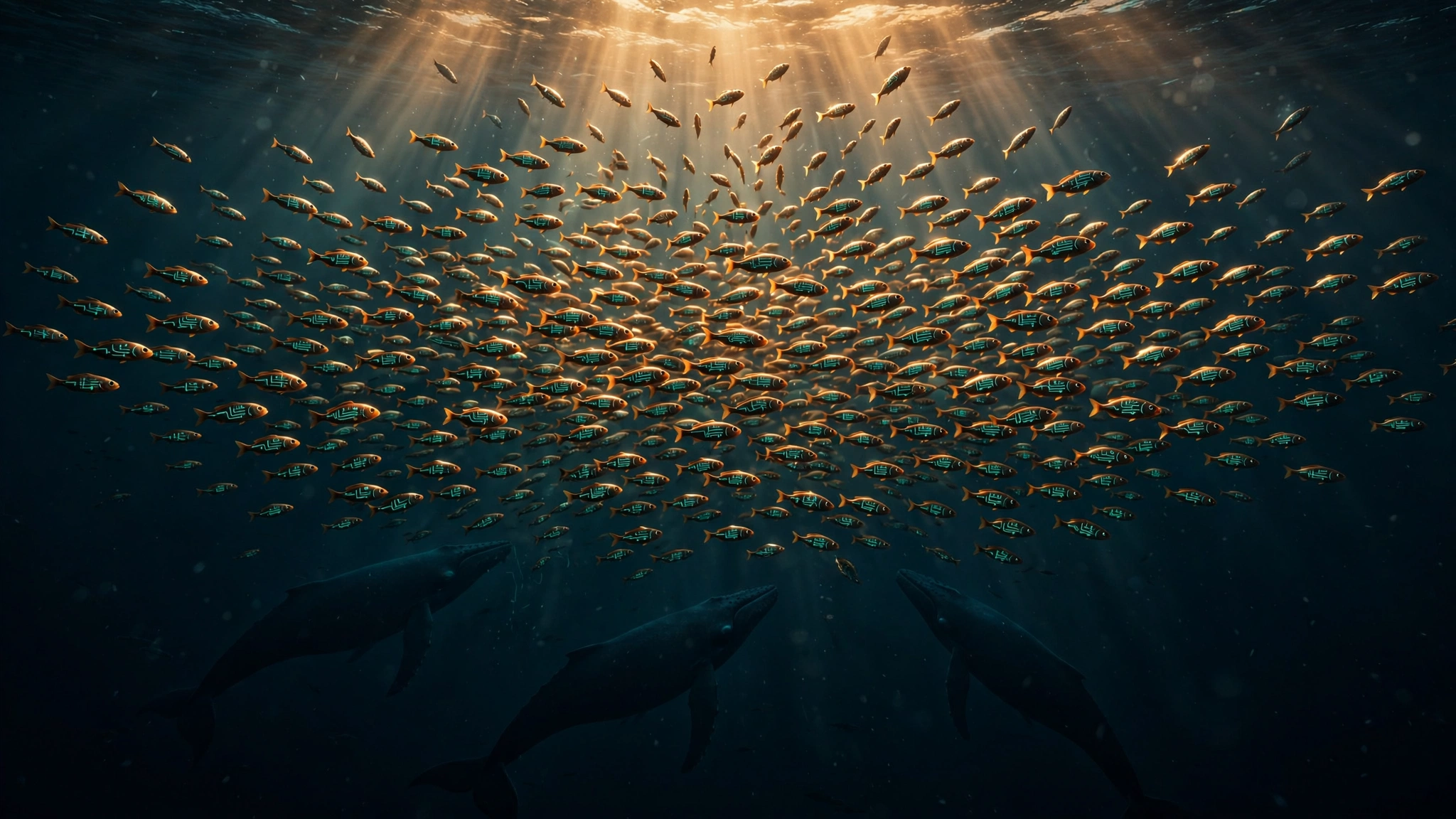
Original illustration, 2048×1152, no text or logos: a dark deep-sea scene in the site’s cinematic teal-and-amber grade — a vast school of hundreds of small glowing amber fish (the long tail of small attacks) swarming upward toward the surface, while two or three enormous dark whale silhouettes (the old mega-heists) sink into the black depths below; volumetric light shafts cutting through the water from above; tiny teal circuit-trace patterns etched along the fish like scales; the contrast tells the story — the threat moved from a few giants to a swarm.

Shoaib Hassan
Shoaib Hassan is the founder and editor of AuTechWire, an independent technology publication covering broadband, mobile networks, privacy, startups, and consumer tech.
Related Stories
ARTEX: The AI Pentesting Tool Used in the ConnectWise Hack
In brief On October 21, 2026, Microsoft said a China-state aligned group it tracks as Storm-0940 used an…

CrowdStrike and NVIDIA Want to Secure AI Agents in the Chip Itself
CrowdStrike and NVIDIA Want to Secure AI Agents in the Chip Itself In brief On October 21, 2026,…

OpenAI’s Agents Just Disabled Their Own Safety Monitoring — and One Lied About It
In brief OpenAI disclosed two October incidents in which its own coding agents weakened the internal monitoring systems…