In brief
- What happened: The Voyager 1 data glitch began November 14, days before the probe crossed one light-day from Earth. The carrier works. What’s broken, and can NASA fix it?
- What the carrier proves: The spacecraft’s antenna, transmitter, and navigation computer are all working. The fault sits further inside, in the computer that gathers and packages the data.
- The date is not a coincidence: Voyager 1 went silent on the same date, November 14, in 2023. That fault took five months to fix.
- The clock is the problem: A radio signal takes 24 hours to reach the probe and 24 hours to come back. Every diagnostic question costs two days.
- What’s left to lose: Two of the ten science instruments are still running. The power source fades about four watts a year.
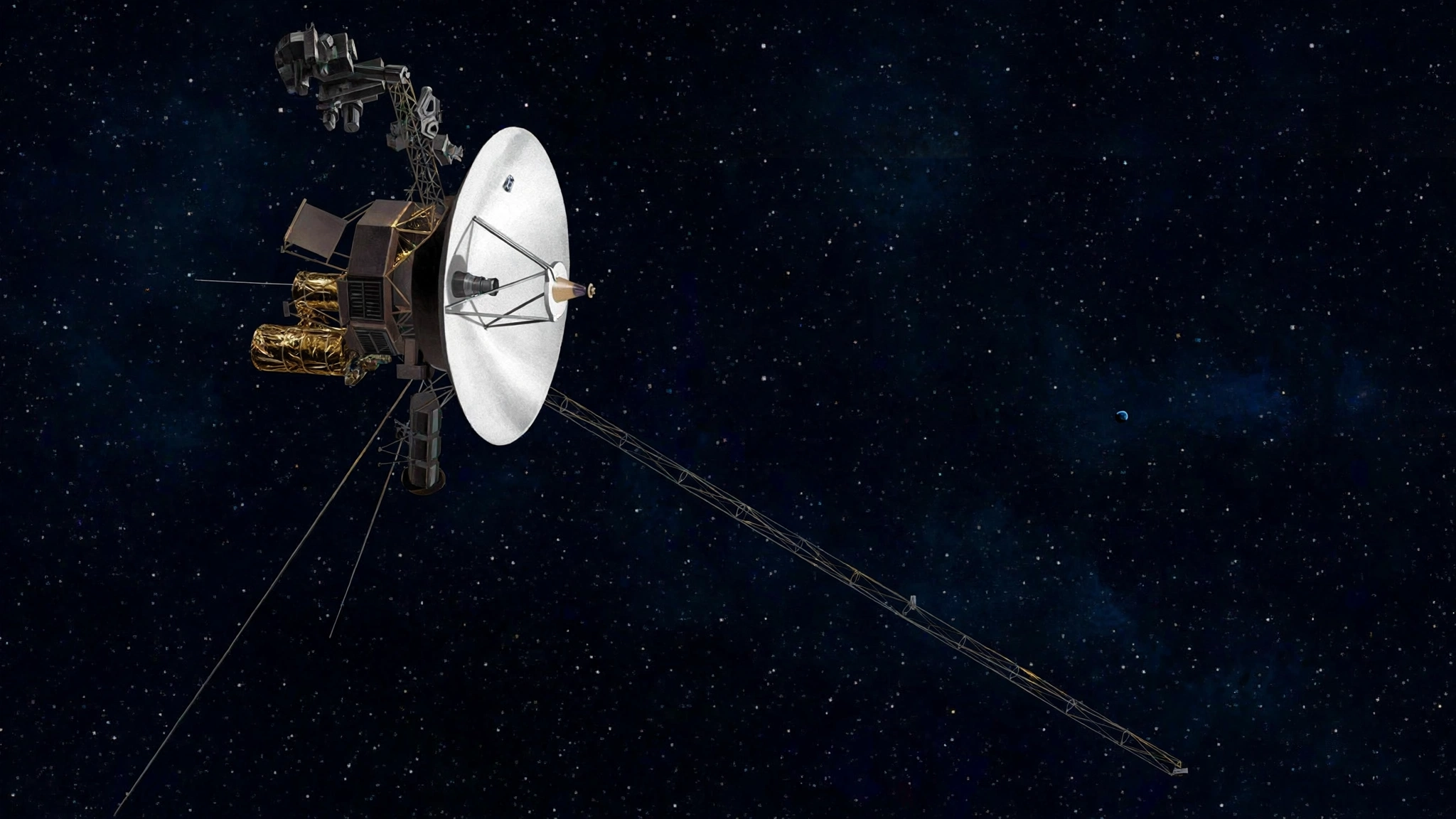
Voyager 1 is 16.1 billion miles from Earth. A radio signal needs a full day to get there, and a full day to come back. On November 14, the Voyager 1 data glitch struck: the spacecraft stopped sending data, and NASA’s engineers were left with the oldest problem in deep-space flight. A machine you cannot touch. A signal you cannot read. A two-day delay on every question you ask it.
Four days later, the probe crossed a line no human-made object had ever crossed. It became the first spacecraft one light-day from Earth, at 2:16 a.m. PST on November 18. NASA confirmed the milestone the next day, using the carrier signal and trajectory calculations. The celebration and the silence arrived in the same week.
The line is open. Nobody is speaking.
Think of it as a phone call where the line is live and nobody talks. On November 14, a NASA Deep Space Network antenna in Canberra, Australia, locked onto Voyager 1 and heard its carrier signal. The carrier is the radio wave itself, the part that carries the data. It was there. The data was not.
That split tells engineers a lot. A carrier means the spacecraft’s navigation computer is still keeping it pointed at Earth, and its antenna and broadcast equipment still work. The failure sits in the part of the machine that collects readings from the instruments and subsystems and packs them into a form the transmitter can send. NASA calls that job the flight data subsystem, one of three onboard computers. In 2023, that computer was the culprit. This time, NASA has not confirmed it is the culprit. The evidence points that way. The confirmation does not exist yet.
A NASA spokesperson told CNN the issue is still ongoing and offered no further details. That was November 24, ten days after the data stopped. The spacecraft is still transmitting its carrier. It is still not saying anything.
The same date, three years apart
November 14, 2023. Same date, same symptom. Voyager 1 kept sending a carrier, and the data it carried turned to gibberish, a repeating pattern of ones and zeros. The flight data subsystem had stopped talking to the telemetry unit properly. It took months to find out why.
In March 2024, engineers sent a carefully chosen command, a poke, that told the computer to run its software in a different order. The reply came back as a readout of the computer’s entire memory. About 3 percent of it was corrupted. A single chip, responsible for storing part of the flight data subsystem’s memory, had stopped working. NASA could not say whether a high-energy particle from space or 46 years of wear killed it.
The chip could not be replaced. So the team did the only thing left. They divided the affected code into sections, stored those sections in different parts of the memory that still worked, and rewrote the references so the pieces could find each other. The first section went up on April 18, 2024. On April 20, readable engineering data arrived for the first time in five months. Science data started coming back in May. By mid-June, all four instruments still operating were returning usable data.
Five months, start to finish. And the probe was 15 billion miles away then. It is 16.1 billion miles away now.
Every question costs two days
This is the part that makes the repair so slow. A command sent today reaches Voyager 1 tomorrow. The answer comes back the day after that. NASA puts it plainly in its November 18 update: diagnosing the cause may take weeks or longer.
The 2023 fix shows what that timeline looks like in practice. Find the fault. Devise a workaround. Send it in pieces. Wait two days to learn whether each piece worked. There is no way to hurry light, and there is no shortcut around the distance. Voyager project scientist Linda Spilker put the scale of it in one line: “The Earth and Voyager are exactly 24 hours apart at the speed of light.”
That is also why the milestone matters beyond the record books. One light-day is a distance measured in time. From here on, every instruction NASA sends is a day old when it arrives, and every answer is a day old when it lands.
October went dark first
The November silence was not the first interruption this fall. In October, Voyager 1 lost all contact for about 48 hours. Then it came back on its own and ran normally until November 14. NASA says engineers are investigating whether the two events are connected.
That October gap is now a suspect, not an explanation. If the same fault caused both, the November fix may be harder than a single failed chip. If they are unrelated, the spacecraft has developed two problems in a month, which is its own kind of warning. Either way, the October blackout is part of the diagnosis now, and it will take weeks of two-day questions to sort out which story is true.
Two instruments left, and a battery that only shrinks
Voyager 1 launched on September 5, 1977, with ten science instruments. Two still operate: the magnetometer, which measures magnetic fields, and the plasma wave instrument, which listens to plasma waves. The cosmic ray subsystem was switched off in February 2025. The low-energy charged particle instrument was switched off on April 17, 2026. The rest were turned off years ago or stopped working.
Power is the reason. The spacecraft runs on plutonium generators that lose about four watts of capacity every year. Engineers have been switching off heaters and instruments one by one to keep the core systems alive. In early September, they swapped three power-hungry devices for lower-power alternatives to buy more time for the two instruments still running.
That is the frame the repair has to fit inside. Even if the data comes back, the spacecraft is running on a shrinking budget. The question is not only whether NASA can fix this fault. It is how many more faults the remaining power and the remaining instruments can absorb.
Can NASA fix the Voyager 1 data glitch?
The honest answer starts with what 2023 proved. A team on Earth can repair a computer it will never touch, given months and a clear diagnosis. The playbook exists, and the people who wrote it are still on the mission.
Three things have to go right. The fault has to be identifiable from 16 billion miles away. The workaround has to fit in the memory that still works. And the spacecraft has to stay alive through weeks of silent troubleshooting while the team works through the possibilities two days at a time.
The 2023 fix took five months, and the probe was closer and stronger then. NASA has given no timeline for this one, and no honest timeline exists yet. A return of engineering data would be the first sign the fix is working. Science data would follow, weeks or months later, if it follows at all.
What happens next
Watch the NASA Voyager mission blog. That is where the updates land, and where the first word of recovered data will appear. Engineering data comes first, science data second, and the gap between them is the measure of how hard the repair turns out to be.
The milestone still stands. Voyager 1 is the first human-made object one light-day from Earth, and it crossed that line on schedule. The spacecraft keeps flying at about 38,000 miles per hour whether or not it can talk, and the Golden Record is still aboard. The question now is whether the two instruments still listening in interstellar space get their voice back.
Sources
NASA mission blog (2026-11-18, updated 2026-11-20, Nov 14 data stop, carrier signal, 24-hour one-way delay, October 48-hour gap, 2023 parallel); NASA news release (2026-11-19, one light-day reached Nov 18 at 2:16 a.m. PST, 16.1 billion miles / 25.9 billion kilometers); NASA mission blog (2024-04-22, 2023 FDS fault, single failed chip, code relocated in sections, first section sent Apr 18 2024, readable engineering data Apr 20); NASA Interstellar Science (two instruments operating on Voyager 1; cosmic ray subsystem off Feb 25, 2025; low-energy charged particle instrument off Apr 17, 2026); CNN (2026-11-24, JPL spokesperson: issue still ongoing; two of ten instruments operating; 2023 parallel; FDS not yet confirmed as the cause); New York Times (2026-11-18, light-day milestone coverage).
Last verified November 27, 2026.
Related Stories

Silksong Sea of Sorrow: What Team Cherry’s ‘Cherry Time’ Presentation Could Finally Reveal
Team Cherry's "Cherry Time" airs Friday, November 27, with a Sea of Sorrow update.
Read
VPN for Streaming: Why Blocks Happen and What Actually Fixes Them
How streaming services spot VPN traffic, the fix ladder to work through in order, and the honest limit no provider can promise past.
Read
NVIDIA RTX Spark Laptops Explained: Should You Buy One?
NVIDIA's new laptops put up to 128GB of unified memory in a Windows machine built to run AI locally.
Read
H-1B Salary Threshold 2026 Bill: What the $140,000 Proposal Does
A bill now in both chambers of Congress would lift the H-1B salary exemption from $60,000 , frozen since 1998 , to roughly $140,000, tied to a live wage index.
Read
VPN Statistics 2026: 50+ Usage Facts, Market Data & Trends
Roughly a quarter of everyone online uses a VPN.
Read