In brief
The FAA stopped every US departure on 13 November 2026 after a new router flooded its legacy network. What broke, how big it was, and what comes next.
- The FAA ordered a nationwide ground stop at 3:54 p.m. ET on Friday, November 13, 2026, after its telecommunications network became unstable. The order was cancelled at 8:19 p.m. ET.
- Operators cancelled about 12,462 flights that day, 9,082 of them at major airlines, according to the FAA. FlightAware counted more than 15,000 US flights delayed or cancelled on Friday.
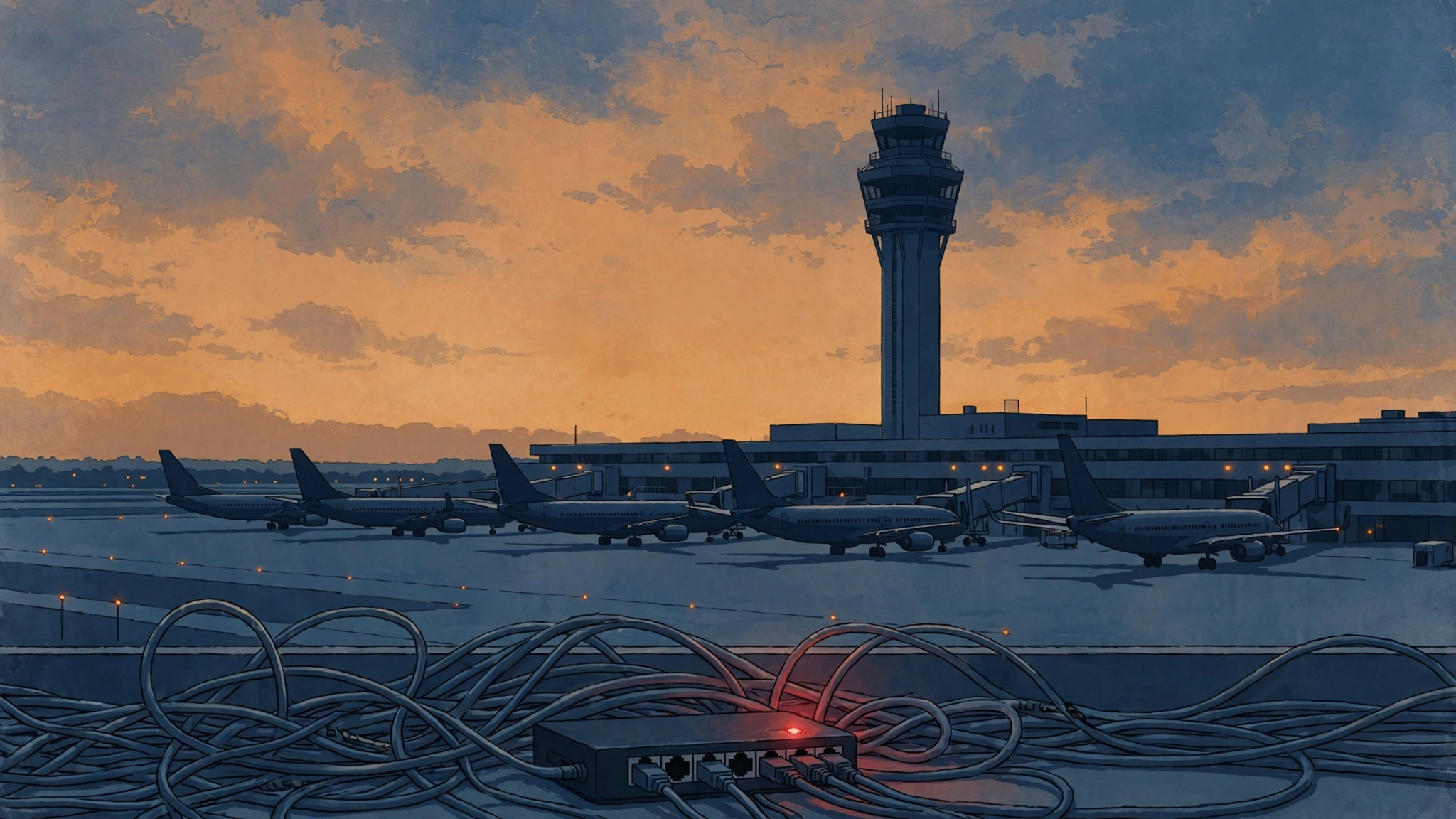
- The trouble traced to a new router being installed by contractor L3Harris at a radio site in El Dorado, Arkansas, which flooded the FAA’s legacy network with about 1,000 connection attempts every four to five seconds. A radar site in Amarillo, Texas, was the second suspected source.
- Instability reached 17 of the FAA’s 22 en route control centres. About 3,500 aircraft already in the air landed safely.
- The FAA says it has no indication this was a cyberattack, and the root cause is still under investigation.
Last verified November 28, 2026.
The most consequential aviation failure in the United States this year did not start in the sky. It started at a radio site in a small Arkansas city, during routine work the FAA says had been done the same way for decades. By the time the afternoon was over, every airport in the country had been told to stop releasing departures, and the agency in charge of American airspace was explaining how one router job had unsettled its communications network.
Four hours with the country closed to departures
The FAA puts the start of the trouble at about 3:30 p.m. Eastern on Friday, November 13. At 3:54 p.m., its Air Traffic Control System Command Center issued advisory 111, headed “National Ground Stop.” The text was short and left no room for interpretation: “Due to extraordinary circumstances and for reasons of safety. Attention all aircraft operators, by order of the Federal Aviation Command Center all airports are ground stopped. All departing traffic should remain ground stopped until further notice. Inbound international flights will be managed on a case by case basis.”
The order stood for a little over four hours. The FAA says traffic resumed as of 8:15 p.m., and the cancellation went out as advisory 005 at 8:19 p.m. By Saturday morning the agency’s airport status page listed no ground stops and no delay programs.
What was already in the air kept flying. About 3,500 aircraft landed safely after the order went out, according to the FAA, and every passenger arrived safely. Critical flights kept operating through the stop. The FAA says some radio frequencies and radar feeds stayed reliable throughout, which is how controllers kept talking to pilots and tracking aircraft while the rest of the system faltered. This was a failure that took away the tools controllers use to separate traffic, and the agency’s answer was to stop adding traffic until the tools came back.
A router swap at a remote site
The network that failed is the FAA Telecommunications Infrastructure, known as FTI. It links the agency’s facilities across the country, and L3Harris has operated it for the FAA for more than two decades. The work under way on November 13 was part of a long migration: copper telephone lines coming out, fibre going in, and old time division multiplexing equipment giving way to internet protocol gear.
At the El Dorado radio site, L3Harris was deploying a new router as part of that change. Shortly after it went live, the FAA says, data began flooding the FTI network at a rate of about 1,000 connection attempts every four to five seconds. The legacy equipment on the network could not take it. A radar site in Amarillo, Texas, was the second suspected source. Once L3Harris blocked traffic from both sites, the network stabilised.
The FAA’s own account is careful about what it does and does not know. It calls the two sites “potential” locations and says the root cause is still being investigated by the agency and L3Harris. What it has confirmed is the shape of the failure: new equipment talking too loudly for old equipment to hear, at 17 of its 22 Air Route Traffic Control Centres, spreading into several terminal radar facilities as well.
The immediate response was to stop the bleeding and then to stop the work. The FAA disabled the broadcasting function on the new routers, and as a precaution it disabled the same function on more than 60 other Juniper routers in the system. It has paused installing them. The router work had been done in the afternoon, and the FAA says maintenance at major facilities is usually done at night. This was a routine replacement at a remote facility, the kind it says has been done for decades without trouble, but the agency says it will reevaluate when replacement and maintenance work is done.
The scale of the day
The FAA’s count is about 12,462 flights cancelled on Friday, November 13, including 9,082 at major airlines. The agency notes that not every cancellation was directly caused by the ground stop, since airlines were already cancelling as the disruption rippled through their schedules. FlightAware, which tracks flights directly, counted more than 15,000 US flights either delayed or cancelled on Friday, and more than 2 million passengers affected, according to a report in Washington Technology.
The damage did not end when the order was lifted. Airlines spent the weekend repositioning aircraft and crews, and the cancellations kept coming. The Congressional Research Service, citing NBC News, put the knock-on at about 6,700 cancellations on Saturday, November 14, and more than 2,300 on Sunday, November 15. JetBlue called off its remaining flights for Friday. United said at 8:10 p.m. Central time that it was resuming operations. Delta and Southwest resumed with warnings that disruption would run into the weekend. Transportation Secretary Sean Duffy said the FAA would prioritise larger flights as the system came back, and that schedules should be back on track before the Thanksgiving rush.
The cyberattack question
Within hours of the stop, the question was whether someone had done this on purpose. The FAA’s answer has been consistent: based on all available evidence, it has no indication this was a cyberattack or an outside actor. Homeland Security Secretary Markwayne Mullin said the same, while adding that investigators were not ruling anything out. The agencies brought in to check included the National Security Agency, the Defense Department, the Cybersecurity and Infrastructure Security Agency and FEMA. The FAA also says the failure was not linked to the Microsoft outage earlier that week, and that its SMART data system, which some reports had pointed to, does not feed information into air traffic control.
Duffy put the blame squarely on the age of the system. “This is a legacy system problem that took place tonight, and we have to handle it accordingly,” he said at a White House briefing that evening. “Our switches, our routers, actually got overloaded with data, and they went down. They started to give us inconsistency in the data from those routers. And because of that, we shut the system down.”
That account is not accepted by everyone who works the system. Some air traffic controllers do not buy Duffy’s explanation, according to a national security reporter for the Washington Examiner, a scepticism CNN also reported. The FAA has not published a final technical report, so the argument over what exactly happened at El Dorado and Amarillo is still open. What is settled is that nobody has produced evidence of an intrusion, and the two explanations on the table are a faulty router and a faulty installation.
An old network being rebuilt while it runs
The ground stop landed on a system that was already mid-rebuild, and the rebuild is the reason the router was being installed at all. L3Harris says 70 percent of FAA sites had been upgraded to fibre optics as of November 2, 2026. A week before the ground stop, the FAA announced plans to phase out the floppy disks still used for weather and other critical information at air traffic control centres, replacing them at more than 400 facilities by the end of 2028. That announcement, reported by Reuters, landed as a neat illustration of how old the network is. The disks hold 1.44 megabytes each.
Nationwide ground stops are rare. Since 2000, the FAA had ordered only two before this one: the failure of the NOTAM pilot-alert system on January 11, 2023, and the attacks of September 11, 2001. A regional version had happened more recently. On September 21, 2026, a primary communications circuit failed at the Philadelphia radar facility while its backup was unavailable because a fibre cable had been severed by railroad construction in New Jersey, and the FAA stopped departures across the New York, New Jersey and Philadelphia area for about eight hours.
The money argument started the same night. The 2025 budget reconciliation act had already appropriated 12.5 billion dollars for air traffic modernisation, including 4.75 billion for telecommunications. After the ground stop, Duffy urged Congress to approve 50 billion dollars in emergency funding, up from an earlier request of 30 billion. The Modern Skies Act, introduced by Senator Eric Schmitt, would provide 30 billion in additional funding. The Government Accountability Office had warned in September 2026 that the FAA’s modernisation programme, known as the Brand New Air Traffic Control System, may be prioritising speed over long-range planning, with risks of cost overruns and prolonged reliance on outdated systems. The programme aims to finish its upgrades by the end of 2028.
What happens next
The FAA and L3Harris are still investigating the root cause, and no final report has been published. The agency has said it will reevaluate when replacement and maintenance work is done, and it has paused the router installations that were under way. Congress is now being asked to fund the modernisation faster, with Duffy warning that more disruption will follow unless the system is updated. The schedules recovered before Thanksgiving, as Duffy predicted. The network that carries them is still the one that failed on a Friday afternoon in November, and the work to replace it is still under way.
Related: Delta’s system outage nine days later, a weight-and-balance failure grounded half its schedule, and the same single-point-of-failure shape showed up again.
Sources: FAA (Nov 15, 2026 — ground-stop Q&A: 1,000 connection attempts every 4–5 seconds, El Dorado and Amarillo sites, 17 of 22 centres, 12,462 cancellations, 3,500 aircraft landed, no cyberattack indication, 60+ Juniper routers disabled); Congressional Research Service (Nov 18, 2026 — knock-on cancellations, $12.5 billion appropriation, $50 billion emergency request, Modern Skies Act, GAO warning); FlightAware (Nov 13, 2026 — more than 15,000 US flights delayed or cancelled); Washington Technology (Nov 13, 2026 — more than 2 million passengers affected); General Aviation News (Nov 16, 2026 — the FAA’s explanation); AIAA (Nov 16, 2026 — router malfunction identified).
Last verified November 28, 2026.
Related Stories

NASA’s Deep Space Network: The Three Antennas Talking to Voyager 1
Voyager 1 is one light-day from Earth, and the Deep Space Network is the only thread holding it.
Read
Silksong Sea of Sorrow: What Team Cherry’s ‘Cherry Time’ Presentation Could Finally Reveal
Team Cherry's "Cherry Time" airs Friday, November 27, with a Sea of Sorrow update.
Read
Voyager 1 Data Glitch: What’s Wrong and Can NASA Fix It?
What happened: The Voyager 1 data glitch began November 14, days before the probe crossed one light-day from Earth.
Read
VPN for Streaming: Why Blocks Happen and What Actually Fixes Them
How streaming services spot VPN traffic, the fix ladder to work through in order, and the honest limit no provider can promise past.
Read
NVIDIA RTX Spark Laptops Explained: Should You Buy One?
NVIDIA's new laptops put up to 128GB of unified memory in a Windows machine built to run AI locally.
Read