NBN fixed wireless used to mean slow internet with a long wait. After a $750 million upgrade, it now reaches around 800,000 regional and rural premises at speeds up to 400 Mbps. Here is how it works, what it really delivers in the evening, and who should sign up.
If you live beyond the reach of the NBN’s fixed-line network, fixed wireless is probably the connection NBN Co has earmarked for your address. Instead of a cable to your door, your internet arrives by radio: fibre runs to a tower near your town, and the tower beams your connection to a small antenna on your roof. For years that meant modest speeds and a reputation for congestion. Then NBN Co spent two years and $750 million rebuilding the network, and the picture changed. The top speed on fixed wireless is now 400 Mbps, and average download speeds have more than doubled since 2022. The catch — and the thing most plan pages gloss over — is that the headline speed is not what you will see at 8 pm. This guide explains the gap, the tiers, and the prices, so you can pick the right plan.
How NBN fixed wireless actually works
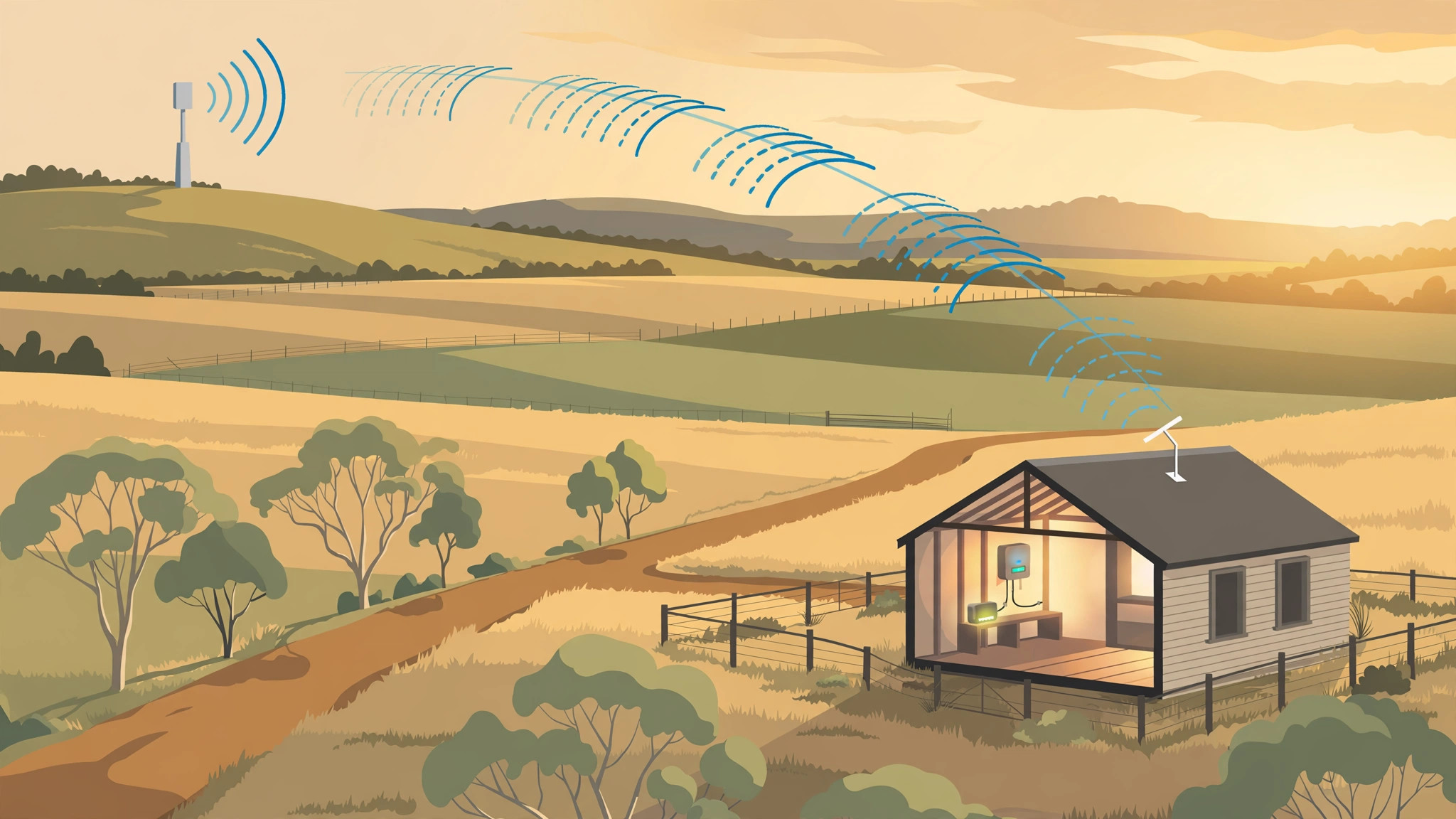
The chain has four links. Fibre-optic cable carries data to an NBN fixed wireless tower, typically on a hill or tall structure serving your district. The tower transmits your connection by radio to an outdoor antenna installed on your property, usually on the roof. A cable runs from the antenna to an NBN connection box (a network termination device) inside your home, and your modem plugs into that box to distribute Wi-Fi and Ethernet around the house.
Two things about that chain matter more than anything else. First, it needs a clear line of sight. The antenna must be able to “see” the tower. Trees, ridgelines, neighbouring buildings and even metal roofing can weaken or block the signal. If the technician cannot get a strong enough signal at your address, the installation does not proceed — there is no point selling you a service that will not work.
Second, the connection is shared. Your tower serves every fixed wireless customer in its area, and you all draw on the same pool of radio capacity. That is why speeds vary through the day, and why the busy evening period (7 pm to 11 pm) is when performance dips. It is the fundamental difference between fixed wireless and a fixed-line connection, where the line to your premises is yours alone.
The network itself has changed underneath. The upgrade program rebuilt more than 2,300 towers with modern 4G and 5G equipment, including long-range 5G mmWave technology — a first at national scale for a dedicated fixed wireless network. NBN Co says thousands of customers are already using mmWave connections, some as far as 6.9 kilometres from their tower, and it plans to stretch that reach to around 11 kilometres. Millimetre-wave signals are fast but fragile: heavy rain can degrade them. Every connection also stays anchored to a mid-band network, so when the weather hits the high-frequency signal, the service falls back to a solid connection rather than dropping out.
The connection box matters too. The current device, NBN Co’s WNTDv4, is the hardware that makes the faster tiers possible. If you are on an old fixed wireless plan and want a faster tier, your provider will arrange the upgraded connection box as part of the move — NBN Co does not charge providers for the upgrade itself.
The speed tiers: headline vs evening reality
NBN fixed wireless now comes in four wholesale tiers. The wholesale tier is what NBN Co sells to your provider; the retail plan you buy sits on top of it.
- Fixed Wireless 25/5. The entry tier, still sold by some providers. Peak speeds of 25 Mbps down and 5 Mbps up. Enough for a single person or a light-use household.
- Fixed Wireless Plus (100/20). The popular tier. Peak speeds of 100 Mbps down and 20 Mbps up — boosted from 75/10 under the upgrade program.
- Fixed Wireless Home Fast (200-250/8-20). Available to around 90 per cent of the fixed wireless footprint. Peak speeds of 200-250 Mbps down.
- Fixed Wireless Superfast (400/10-40). Available to around 80 per cent of the footprint. Peak speeds of 400 Mbps down, the fastest ever offered on fixed wireless.
Here is the part that matters for your decision: peak speeds are not evening speeds. Providers publish “typical evening speeds” measured between 7 pm and 11 pm, and on fixed wireless those figures sit far below the headline. Across provider plan pages checked on 13 October 2026, typical evening downloads run around 43-50 Mbps on Plus, around 90 Mbps on Home Fast, and around 95-120 Mbps on Superfast. Uploads are thinner still: typically 5-8 Mbps on Plus and Home Fast, and 8-10 Mbps on Superfast.
That gap is not providers being misleading — it is the shared-network reality, and it is why the Superfast tier is a harder sell than it looks. You pay roughly twice the price of Plus for a headline of 400 Mbps, but in the evening you may see 100 Mbps or so. For a household that streams on two or three screens and works from home, Home Fast’s evening performance is usually the sweet spot. Superfast makes sense if your household has many simultaneous heavy users, or you regularly upload large files and want the extra upload headroom.
One quirk worth knowing: NBN Co “overprovisions” the three faster tiers by 50 per cent at the wholesale level. That means the underlying Layer 2 speeds can reach up to 150 Mbps on Plus, 375 Mbps on Home Fast and 600 Mbps on Superfast when network conditions allow. You may occasionally see speeds above your tier’s headline figure. Do not count on it — NBN Co has not committed to keeping those settings — but it explains why speed tests sometimes surprise people.
Plans and prices in Australia
Fixed wireless plans are sold by retail providers, not by NBN Co. Prices below are ongoing monthly prices as at 13 October 2026, from provider plan pages. Most plans include unlimited data and no lock-in contract. Six-month introductory discounts are common, so check the ongoing price — that is what you will pay long-term.
| Wholesale tier | Typical evening download | Ongoing price range | Who it suits |
|---|---|---|---|
| Fixed Wireless 25/5 | ~25 Mbps | From ~$70/mth | Single person, light use |
| Fixed Wireless Plus (100/20) | ~43-50 Mbps | ~$75-90/mth | 2+ people, everyday streaming and browsing |
| Fixed Wireless Home Fast (200-250/8-20) | ~90 Mbps | ~$80-100/mth | Families, working from home, 4K streaming |
| Fixed Wireless Superfast (400/10-40) | ~95-120 Mbps | ~$90-125/mth | Large households, heavy uploaders |
As a worked example, MATE’s three fixed wireless plans are priced at $90 a month for Plus (typical evening 48 Mbps down, 8 Mbps up), $100 for Home Fast (90/8), and $125 for Superfast (95/10), each discounted for the first six months. Cheaper providers undercut those figures — Activ8me lists Home Fast at $89.95 a month and Super Fast at $112.95, while Leaptel lists Superfast at $90 a month for the first 12 months (then $108 ongoing), with a typical evening speed of 120 Mbps down. The spread shows why it pays to compare: the same wholesale tier can cost $25 a month more or less depending on the provider.
Standard installation is typically included in the plan price. The technician installs the outdoor antenna and the indoor connection box, and your provider supplies or sells you a modem. Allow up to around four weeks from ordering to installation, depending on technician availability in your area.
Fixed wireless vs the alternatives
Fixed wireless is not the only option for homes beyond the fixed-line footprint, and the right choice depends on what is actually available at your address.
Fixed-line NBN. If your address can get a fixed-line connection — fibre, HFC or even FTTN — take it. It is more consistent than wireless, especially in the evening, and the fastest tiers go far higher. Our guide to NBN speeds explains which tier suits your household.
NBN Sky Muster satellite. The service for premises too remote for fixed wireless. Standard plans top out near 25 Mbps with latency around 660 milliseconds — the physics of a signal travelling to geostationary orbit and back. Sky Muster Plus lifts speeds to 100 Mbps and removes data caps on some tiers, but the latency cannot be fixed. If your household depends on video calls, telehealth or remote work, satellite will frustrate you. Fixed wireless, with latency far closer to a fixed-line connection, is a major step up wherever it is available. That is exactly why NBN Co moved more than 120,000 premises from the satellite footprint onto fixed wireless during the upgrade — it also freed satellite capacity for uncapped data plans for those who remain.
5G home internet. In towns with strong 5G coverage, Telstra, Optus or TPG 5G home internet can deliver 50-300 Mbps for roughly $59-99 a month with no technician visit and no antenna. Worth a coverage check before committing. Our 5G vs NBN comparison covers the trade-offs: 5G is easier to set up, but its speeds vary more and uploads are weaker. Fixed wireless wins where 5G coverage is patchy or congested.
Starlink. SpaceX’s satellite service delivers around 197 Mbps in busy hours with ~25 ms latency, per ACCC independent testing, at $75 a month and up plus hardware. It is faster than fixed wireless and available almost anywhere, but it costs more all-in and needs a dish you install yourself. Our Starlink guide has the full comparison. For most households inside the fixed wireless footprint, fixed wireless is the better-value option; Starlink is the fallback when fixed wireless is not available or not fast enough.
Who should get NBN fixed wireless?
Fixed wireless is worth it if you: live in regional or rural Australia without a fixed-line NBN connection; want a professionally installed, always-on connection with unlimited data; need reliable video calls and remote work from a rural property; or have been stuck on Sky Muster satellite and can now move across. For these households, the upgrade program genuinely changed the equation — 100 Mbps-class evening speeds at $75-90 a month is a different service from what fixed wireless offered a few years ago.
Think twice if you: can get fixed-line NBN at your address — it is more consistent. Think twice if you need very high uploads (above ~10 Mbps sustained in the evening) — fixed wireless uploads are its weakest point. And think twice if your property has a blocked line of sight to the tower: no plan will fix a signal that cannot get through.
If you are already on fixed wireless: check whether you are on an old plan. The upgrade program boosted Plus from 75/10 to 100/20 and added the two faster tiers, but existing customers do not always get moved automatically. Ask your provider whether your address is eligible for a faster tier, and whether you need the upgraded connection box. If you are on the old 25/5 tier and your household has grown, the jump to Plus or Home Fast is likely the single best-value upgrade available to you.
What this means for you
- Check your address first. Enter your address at nbnco.com.au/check to see whether fixed wireless serves your home and which tiers are available. Availability of Home Fast and Superfast varies by location.
- Judge plans by evening speeds, not headlines. A 400 Mbps headline typically means 95-120 Mbps at 8 pm. Compare providers on their published typical evening speeds.
- Home Fast is the sweet spot for most households. Around 90 Mbps in the evening at $80-100 a month covers streaming, working from home and several devices at once.
- Superfast only pays if you need it. The extra cost buys modest evening gains for most homes. It makes sense for large households and heavy uploaders.
- Compare ongoing prices, not intro offers. Six-month discounts are common. The ongoing monthly price is what you will live with.
- Old-plan holders: ask about the upgrade. If you are on a pre-upgrade plan, your provider can check whether faster tiers and the new connection box are available at your address.