In brief
Delta’s weight-and-balance system failed Sunday, delaying 1,600+ flights days before Thanksgiving. What broke, why it stopped half the schedule, and what you’re owed.
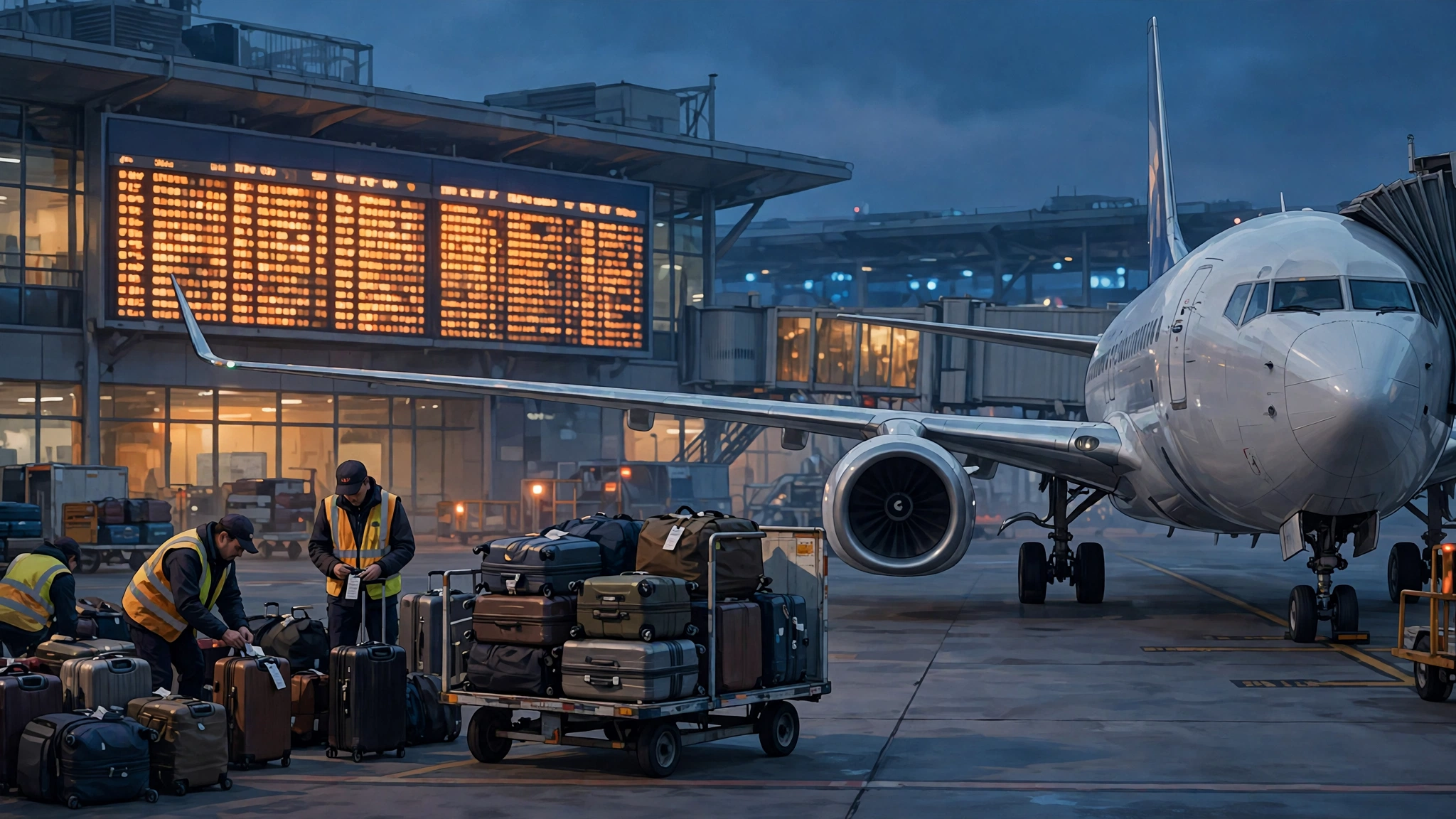
A single computer system tells Delta’s ground crews how to load every departing plane. When it went down on Sunday morning, November 22, 2026, crews went back to counting bags by hand. By the afternoon the airline said the automation was working again, but the delays had already rippled across the country, and they landed nine days after a separate technology failure grounded flights nationwide.
What broke: the computer that weighs the plane
Before any plane leaves the gate, someone has to answer a deceptively simple question: how much does it weigh, and where is that weight sitting? Passengers, fuel, and bags all count, and the balance has to fall inside strict limits or the plane cannot fly safely. Delta answers that question with a system called ALIS, the Automated Load Instruction System, run from its Operations and Customer Center in Atlanta. It produces the load instructions the baggage crews work from.
On Sunday morning that system stopped producing them. Ramp crews had no worksheet to load against. A radio call captured that morning tells the story plainly enough: “Right now, it’s a system-wide outage for Delta Air Lines. The ramp isn’t really able to load because there is no ramp worksheet in there, so that’s what we’re doing, we’re manually counting bags and doing a report for you guys.”
Delta’s public line was that teams were using “manual workarounds” to get flights out safely while technicians restored the automation. In a message to employees seen by The Wall Street Journal, the airline described a “database issue” affecting the system that tracks aircraft-loading information. As of Sunday evening, Delta had not said what caused the problem.
How bad it got
The numbers, all from flight tracker FlightAware: more than 1,600 Delta flights delayed on Sunday, about half of the airline’s mainline schedule, and more than 40 canceled. Delta had about 5,000 flights scheduled for the day. About 70 percent of the day’s disruptions were down to the tech failure; the rest came from bad weather and air traffic slowdowns in New York and the Northeast.
Atlanta took the worst of it. By midday, 835 flights at Hartsfield-Jackson were delayed, and by Sunday evening more than half of departing flights there were running late. The Federal Aviation Administration briefly halted Atlanta-bound traffic, then eased the order to a ground delay that was lifted around 11:30 a.m. ET. The FAA confirmed the problem was Delta’s, not its own: Sunday’s delays were not related to any FAA air traffic system.
By about 3:30 p.m. ET, Delta said the automation was working again. The airline apologized and said teams were focused on completing the rest of the day’s schedule. The disruption is over. The delays it caused are still working their way through rebookings, missed connections, and hotel rooms.
Nine days earlier, the FAA’s own system failed
This was the second time in nine days that a technology failure stopped American air travel. On November 13, an outdated copper wire at a remote location took down FAA systems and triggered a nationwide ground stop that stranded tens of thousands of passengers. The two failures had different causes and different owners. What they share is the shape of the problem: a single system that everything else depends on, with no fast fallback when it breaks.
Airlines have been here before, and the pattern keeps repeating. A load-planning database, a crew-scheduling system, a router at a remote site: each one is a single point of failure dressed up as infrastructure. When it works, nobody thinks about it. When it stops, half a schedule stops with it, and the only backup is people doing by hand what a computer did in seconds.
Thanksgiving makes the timing worse. The holiday week is the busiest stretch of the year for US air travel, and next Sunday, November 29, could be the busiest day of the year to fly. A system that fails on a quiet Tuesday is a headache. The same failure four days before Thanksgiving is a different problem, because there are no spare seats to absorb the displaced passengers.
If you were on one of those flights
Start with the one right that does not depend on anyone’s judgment. Under the Department of Transportation’s automatic refund rule, if Delta canceled your flight, or changed it significantly, and you choose not to travel or accept what the airline offered instead, you are owed a full refund to your original payment method. Significantly changed means three or more hours late on a domestic flight. The refund is due within seven business days for a credit card payment, and it applies whatever caused the disruption. If you accept a rebooking or a credit instead, you generally give up the cash refund, so read the options before you tap accept.
Everything else turns on one word: controllable. The DOT publishes a dashboard of what each large airline has promised for delays and cancellations within its control. For Delta that means free rebooking on Delta, rebooking on a partner airline at no extra cost when Delta has no flight available, a meal or meal voucher when the wait reaches three hours, and a hotel plus transport to and from it if you are stuck overnight. No airline promises cash compensation for a delay. Ask the gate agent whether your delay is classified as controllable, because that classification decides which of those promises apply to you. The failed system was Delta’s own, and the classification is still the thing to confirm in writing.
Do not skip a flight without telling the airline. If you no-show, Delta can cancel the rest of your itinerary, including your return. Change or cancel through the Fly Delta app or delta.com before you walk away from the booking.
One deadline is today. Passengers caught in the November 13 ground stop have a Delta travel waiver that lets them rebook at no fare difference, but only if they change the flight on or before November 23, with the new departure also on or before November 23, in the same cabin, on tickets issued on or before November 15. After today, standard fare rules apply, and Thanksgiving-week fares will not be getting cheaper.
If your flight was canceled outright, check your refund first and your rebooking second. If it was delayed, ask about the controllable classification before you pay for a hotel yourself. And if you are flying Delta this week, check your flight status in the app before you leave for the airport. The system is fixed. The schedule it broke is still catching up.
What Delta hasn’t said yet
The airline has not said what caused the database issue, how long the system was down in total, or what it is changing so that a single load-planning failure cannot ground half the schedule again. Those are the questions that matter for the next failure, and they are the ones worth watching for in Delta’s next update. This page will be updated when Delta answers them.
Sources
CNN (Nov 22, 2026 — ALIS, manual workarounds, ground delay lifted ~11:30 a.m. ET, 55% of Atlanta departures delayed, FAA confirmation); The Wall Street Journal (Nov 22, 2026 — 1,600+ delays, 40+ cancellations, ~70% tech-caused, “database issue” employee message, resolved Sunday afternoon); USA Today (Nov 22, 2026 — automation restored ~3:30 p.m. ET, 5,000 flights scheduled, 835 Atlanta delays by midday); Reuters (Nov 22, 2026 — brief ground stop, weight-and-balance requirement, FAA confirmation); The Points Guy (Nov 22, 2026 — 1,300+ mainline delays by early afternoon, Nov 29 busiest-day warning, hotel/meal note); Delta Air Lines travel advisory (Nov 13 ground-stop waiver: rebook on or before Nov 23, same cabin, tickets issued on or before Nov 15); US Department of Transportation Airline Customer Service Dashboard (controllable delay and cancellation commitments, including Delta’s rebooking, meal, and hotel promises). FlightAware (live flight data — delay and cancellation figures).
Related: Voyager 1’s data glitch, one light-day out — what is wrong with the probe, and whether NASA can fix it from 25 billion kilometres away.
Last verified November 23, 2026. Delay and cancellation figures are FlightAware data reported November 22, 2026.
Related Stories

Switzerland Confirms the First AI-Agent Attacks on Critical Infrastructure
Five AI-agent attacks confirmed in Switzerland, three on critical infrastructure. Four systems compromised.
Read
Your Secrets Went to MiniMax: What Dragos Found and What to Rotate Now
Secret links in prompts sent to MiniMax models were opened, even with zero data retention set.
Read
Claude Opus 5.6 Is Reportedly Being Tested — What’s Confirmed and What’s Just a Rumor
Anthropic is reportedly testing Claude Opus 5.6 in Claude Code. No announcement, no model ID, no price.
Read
Silksong Sea of Sorrow: What Team Cherry’s ‘Cherry Time’ Presentation Could Finally Reveal
Team Cherry's "Cherry Time" airs Friday, November 27, with a Sea of Sorrow update.
Read
Voyager 1 Data Glitch: What’s Wrong and Can NASA Fix It?
What happened: The Voyager 1 data glitch began November 14, days before the probe crossed one light-day from Earth.
Read