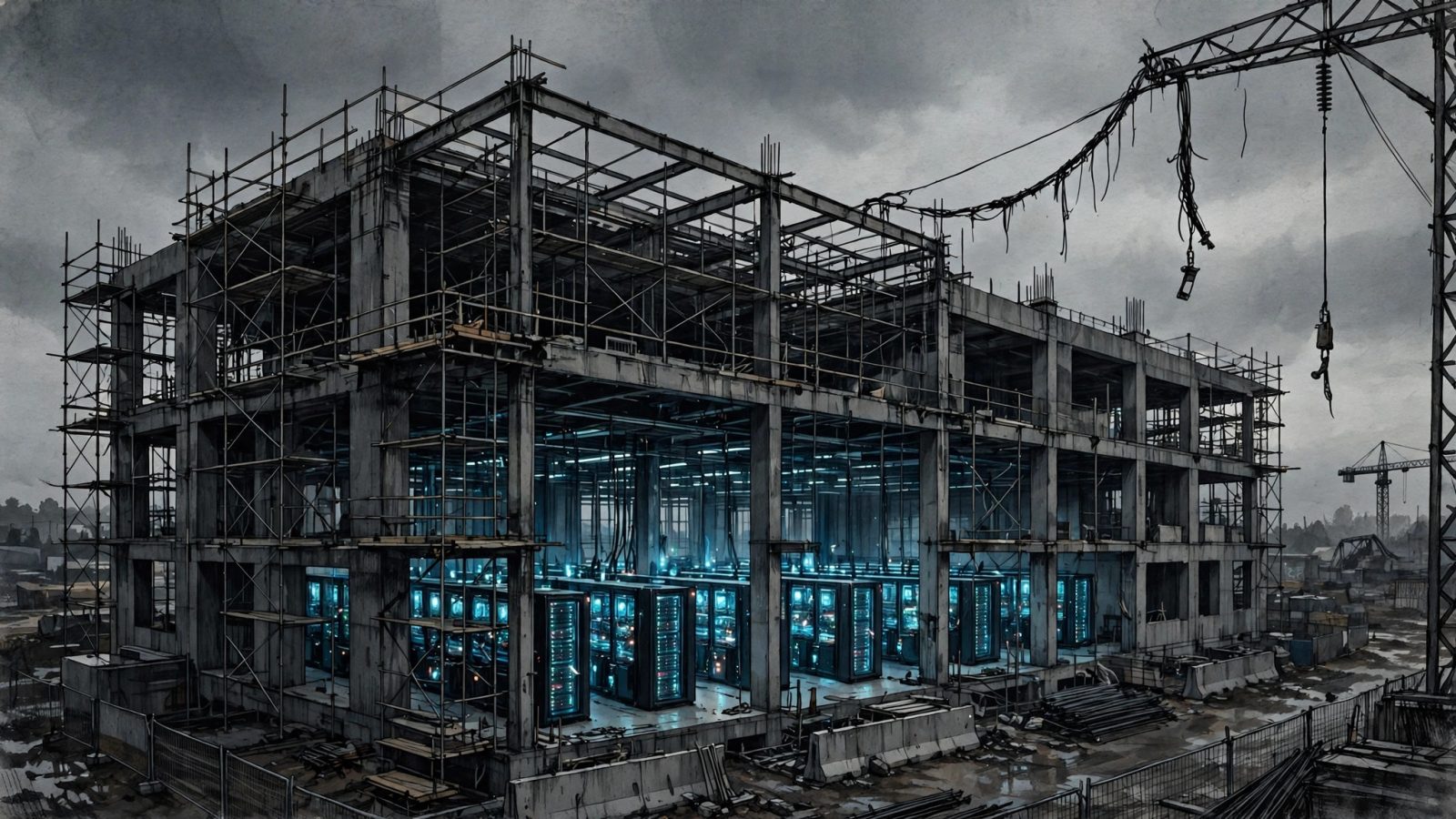
Microsoft has walked away from the site that was supposed to house the United Kingdom’s largest AI supercomputer. The Telegraph reported on October 18 that Microsoft ended its agreement to be the anchor customer at Nscale’s planned AI data center in Loughton, Essex — a £2 billion project meant to host more than 23,000 Nvidia chips for Microsoft’s Azure platform. The reason, according to follow-up reporting: the site could not get electricity. Grid planners reportedly do not expect a power connection there until the 2030s.
In brief
- What happened: Microsoft ended its agreement as anchor customer at Nscale’s planned AI data center in Loughton, Essex — the site meant to house the UK’s largest AI supercomputer (The Telegraph, October 18).
- The scale: a £2 billion project with 23,040 Nvidia GB300 GPUs for Azure, 50 megawatts of initial capacity expandable to 90MW — announced September 2025 as part of a £31 billion US-UK prosperity package.
- The reason: the site cannot get electricity — grid planners reportedly do not expect a power connection until the 2030s; the Guardian reported the launch had already slipped, potentially into the mid-2030s.
- What’s unknown: Microsoft has not publicly explained the withdrawal; the Telegraph’s original report did not specify a reason.
- The signal: the binding constraint on the AI buildout in 2026 is not chips or money — it is the electric grid.
That single sentence — a £2 billion AI campus with no power — explains more about the state of the AI boom than most earnings calls. The binding constraint on artificial intelligence in 2026 is not chips and not money. It is the electric grid.
What actually happened
The Loughton deal was announced in September 2025, during a week of US-UK tech diplomacy that included Nvidia CEO Jensen Huang and Microsoft leadership appearing alongside UK officials as part of a £31 billion US-UK prosperity package. Nscale said the site would deliver 23,040 Nvidia GB300 GPUs — the top-end AI chips — for Microsoft starting in the first quarter of 2027, in a facility with 50 megawatts of initial capacity expandable to 90 megawatts. The BBC reported the Essex site would create up to 250 permanent jobs and open in 2026.
By September 2026, the Guardian reported the project’s launch had slipped — potentially into the mid-2030s — with the grid connection the binding constraint. Now Microsoft, the only publicly announced customer, is gone.
Three things are worth noting about what remains unknown. First, Microsoft has not publicly explained the withdrawal. The Telegraph’s original report did not specify a reason; the Guardian reported that power-supply concerns were behind the decision, but that is reported context, not a company statement. Second, Nscale says it remains committed to Loughton and is exploring alternative power sources plus other UK expansion sites — the site itself is not cancelled. Third, and most important, this exit concerns one Essex agreement. Nscale separately signed a Microsoft deal covering roughly 200,000 GB300 GPUs across its US and European sites, and the company says the wider relationship with Microsoft remains strong and the London grid issue does not affect its other contracts. The story is not “Microsoft abandons Nscale.” It is “Microsoft walked away from one building that could not get power.”
The number that killed the deal: 125 gigawatts
The Loughton story only makes sense against what is happening to Britain’s electricity grid. In July 2026, the energy regulator Ofgem published consultation figures showing that contracted demand-connection offers — the queue of projects waiting to be plugged into the grid — had risen from 41 gigawatts in November 2024 to 125 gigawatts in June 2025. That is a 205% increase in seven months, and it describes connection commitments, not electricity being consumed. Data centers are a large and growing part of that queue.
Ofgem proposed new rules — financial commitments and project milestones — to separate projects that can actually be delivered from speculative applications. The consultation closed in September 2026. But the queue is the queue: a data center operator can sign an anchor customer, pour concrete, and order 23,000 GPUs, and still wait years for the substation that makes any of it work.
AI Industry Today, one of the outlets analyzing the story, put the commercial distinction plainly: securing a customer and securing usable power are two different achievements. A large GPU commitment establishes intended demand. It says nothing about when the site can be energized. Microsoft was planning capacity for 2027. The grid was planning capacity for the 2030s. When those two timetables collided, the customer left.
This is not one company’s problem
What makes the Loughton exit matter beyond Essex is the pattern around it. Nscale’s flagship Norwegian facility is running roughly six months behind schedule, with about 6.4 megawatts of a planned 30 megawatts currently operating, according to Bloomberg reporting. The company is pursuing a US stock-market listing at a potential $35 billion valuation — more than double its $15 billion private valuation — and the Loughton loss lands right as investors are asking harder questions about AI infrastructure debt. In the same week, rival CoreWeave’s shares fell about 25% as concerns persisted over borrowing needs across the sector, and Australian data-center developer Firmus abandoned its IPO after failing to attract demand at its proposed price.
Zubiqo’s analysis of the story noted that more than 40% of Nscale’s roughly $103 billion in contracted revenue comes from Microsoft, alongside major customer Anthropic — so while the Essex deal is believed to be a small part of that total, the exit is a reputational hit precisely when the company is asking public markets to believe in its delivery pipeline.
This is the frame that makes the story an AuTechWire story rather than a wire rewrite: every quarter, the AI industry announces demand in chips, dollars, and megawatts of planned capacity. Every quarter, the physical world — permits, transformers, transmission lines, and the local substation — moves on its own timetable. Analysts and journalists have spent 2026 arguing about whether AI valuations are sustainable. Loughton is evidence for a different constraint: AI infrastructure is subject to hard physical bottlenecks that no amount of financing can compress.
What both sides agree on
It is worth stating what is not in dispute, because the noise around this story has already started.
- Nobody disputes the power constraint is real. Ofgem’s queue figures are public. Nscale itself is “exploring alternative power sources” — its own words confirm the grid is the problem.
- Nobody disputes the site was ambitious and credible. This was not a speculative shed: £2 billion, 23,040 named GPUs, a named anchor customer, announced on a state visit. It failed on physics, not on business model.
- Nobody claims Microsoft is abandoning AI infrastructure. The company’s separate, larger Nscale commitments and its other data-center programs continue. One agreement died; the buildout continues.
The counter-argument worth taking seriously: Nscale says the Loughton exit has no impact on its other contracts and that it is finding alternative power. If the company re-anchors the site with different power arrangements, this story will read as a delay and a renegotiation rather than a cancellation. Infrastructure projects get re-scoped constantly; the dramatic version — “the AI boom is dying” — is not what the facts currently support.
What this means for you
- If you follow the AI industry: stop treating “planned capacity” and “capacity” as the same number. From now on, when an AI data center is announced, ask when its grid connection is confirmed — not when the GPUs ship.
- If you’re in tech, energy, or construction: the grid-connection queue is the new bottleneck skill set. Data-center developers are learning that permitting and power procurement now take longer than construction. Expect “behind-the-meter” power (on-site generation, gas turbines, alternative supplies) to become standard vocabulary in AI infrastructure deals.
- If you live in the UK: the story is also about where tech investment lands. A 250-job, £2 billion project in Essex is on hold because the lights can’t be turned on. The UK government’s AI growth-zone ambitions will be measured against the Ofgem queue, not against press releases.
- What to watch next: whether Nscale announces an alternative anchor tenant or alternative power for Loughton; the company’s US IPO pricing, which will test whether public markets still believe the infrastructure delivery story; and Ofgem’s final queue-reform rules, which decide which of those 125 gigawatts are real projects.
(This article is a technology-industry news explainer. It is not financial advice.)
Sources
- The Energy Mag — Nscale and Anthropic talks after the Microsoft exit (Bloomberg reporting)
- Dealroom — dumped by Microsoft, Nscale nears a second Anthropic deal
Related reading: Is the AI Bubble Bursting? The 10 Warning Signs, Explained · NVIDIA’s RTX Spark Laptops: Local AI, Explained
Update, October 20, 2026: Nscale is now reportedly in talks with Anthropic for a second roughly $45 billion deal — this time for a second building at the Monarch campus in West Virginia, where 460 megawatts of power is deliverable. The buildout is not retreating; it is concentrating on the sites that can actually be switched on.

Shoaib Hassan
Shoaib Hassan is the founder and editor of AuTechWire, an independent technology publication covering broadband, mobile networks, privacy, startups, and consumer tech.
Related Stories

Crypto Hacks Are Surging but Stealing Less — Here’s Why
In brief On October 22, 2026, Haseeb Qureshi, managing partner of the crypto investment firm Dragonfly, said cybersecurity…

ARTEX: The AI Pentesting Tool Used in the ConnectWise Hack
In brief On October 21, 2026, Microsoft said a China-state aligned group it tracks as Storm-0940 used an…

CrowdStrike and NVIDIA Want to Secure AI Agents in the Chip Itself
CrowdStrike and NVIDIA Want to Secure AI Agents in the Chip Itself In brief On October 21, 2026,…