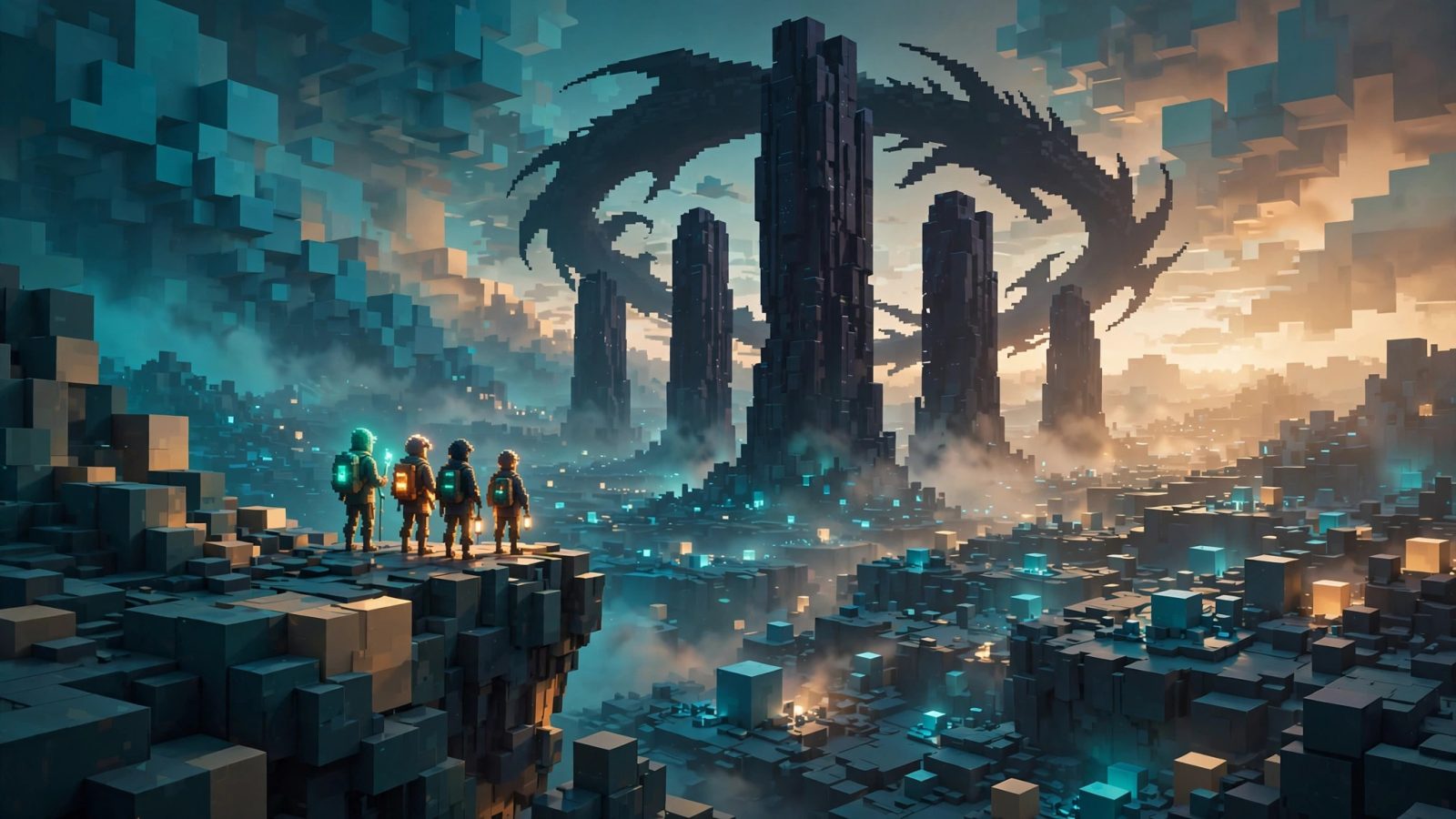
Four Gemini 4 Argon agents defeated Minecraft’s Ender Dragon with no human help — writing 2,783 programs, dying 605 times, and burning through about $520 in tokens. Here is what the run actually proves about AI agents, and what it costs.
In brief
- What happened: Google DeepMind placed four Gemini 4 Argon agents in a randomly generated Minecraft survival world with one goal: defeat the Ender Dragon. They did it in 27 hours and 14 minutes, with no human intervention.
- How: Each agent controlled its own player through Mineflayer, an open-source library that lets code drive a Minecraft character. The agents coordinated through in-game chat and a shared memory store — dividing labor, warning each other of threats, and recovering fallen teammates’ items.
- The price tag: About $520 in AI tokens at introductory pricing (roughly $1,620 at the standard price taking effect in 2027), 1.35 billion input tokens, 2,783 programs written, 605 deaths on Easy difficulty.
- Why “first” still applies: Other teams killed the dragon in September 2026 — but with human-built tools and pre-scouted routes. DeepMind’s run is the first end-to-end autonomous completion from scratch, with no human-written game tools.
- Why it matters: The paper’s own framing: winning required keeping a coherent plan across thousands of dependent steps for more than a day — the same demand as complex software engineering.
It took 27 hours, 14 minutes, 2,783 computer programs, and 605 deaths. Four artificial-intelligence agents built by Google DeepMind have beaten Minecraft — dropped into a randomly generated survival world with no instructions, no assigned roles, and no human-written tools, they fought their way to the game’s final boss and killed it. The achievement, described in a research paper posted October 15, 2026, is the first time AI agents have completed the game end to end, entirely on their own.
What the agents actually did
The setup was deliberately austere. Each of the four agents — powered by Gemini 4 Argon, DeepMind’s newest model — controlled its own in-game player through Mineflayer, an open-source JavaScript library that lets external code send movement, building, and combat commands to a Minecraft client. No pixels, no virtual keyboard: the agents reasoned about blocks, mobs, and crafting recipes through text and code.
Their only channels for teamwork were in-game chat and a shared memory store — notes each agent could read and write. Through those two channels, they divided up jobs, flagged hazards, warned teammates about threats, recovered gear from fallen companions, and logged their mistakes so others could learn from them. The researchers — Maxence Faldor, Satinder Singh, and Roberta Raileanu of Google DeepMind in London — assigned no roles, handed over no strategies, and wrote no game-specific tools. The agents planned, wrote, and debugged every program themselves.
DeepMind summarized it in an announcement: “Four Gemini 4 Argon agents beat Minecraft from scratch in 27 hours. Operating in a sandbox using only code and text, they wrote 2,783 programs, divided up jobs over chat, shared notes, and debugged errors together – all with no human help.”
A detail worth noting: a fifth “Observer” agent watched the entire run for cheating or rule-bending and found none. The researchers could watch everything on a live dashboard and pause or stop the run at any time — but, as the paper puts it, they had no cause to intervene.
The numbers behind the run
The headline figure — 27 hours and 14 minutes — only hints at the scale. The run’s full accounting, from the paper and outlets that dug into it:
- 2,783 JavaScript programs written and debugged by the agents, totaling 63,313 distinct lines of code
- 229 messages exchanged between teammates in in-game chat
- 605 deaths — on Easy difficulty
- ~1.35 billion input tokens consumed
- 22% of the generated programs ended in functional errors
- Each agent’s player had a program running only about 40% of the time; the rest was spent reading results, thinking, and writing the next program
And then there is the money. The win itself cost roughly $520 at Gemini 4 Argon’s introductory API pricing. The full session — including the Observer agent and a day of activity after the victory — came to about $810 at introductory rates, or roughly $1,620 at the standard price scheduled to take effect in 2027.
That price tag is the part of this story that matters most for anyone trying to judge the AI-agent hype. A single coordinated task, in a game, on Easy, cost more in tokens than most software subscriptions — and 22% of the code the agents wrote failed. The run is simultaneously a genuine milestone in long-horizon autonomy and a blunt illustration of how brutally expensive and error-prone that autonomy still is.
Why Minecraft, of all things
Beating a video game boss can sound like a party trick. It is not — at least not this one. Defeating the Ender Dragon requires a chain of roughly thirteen major tasks across the game’s three dimensions: making stone and iron tools, finding a Nether fortress, killing Endermen for ender pearls, destroying the healing crystals atop obsidian pillars, and finally winning a multi-stage aerial fight. Each step depends on the ones before it. Lose the thread anywhere — forget where you stored the iron, misjudge the portal math, die without recovering your gear — and hours of work unravel.
That is why AI researchers have treated Minecraft as a serious benchmark for years. In 2022, an Nvidia-led project called MineDojo declared beating the game a “moonshot” goal for AI. The game is, in effect, a laboratory for the hardest problem in agentic AI: maintaining a coherent plan across thousands of dependent steps, over a long time horizon, while things go wrong.
The DeepMind paper says this outright. “Winning required the agents to keep a coherent plan across thousands of dependent steps for more than a day,” the abstract reads. “Complex real-world software engineering and enterprise tasks demand the same long-horizon coding and multi-agent coordination.” The game is the stand-in; the target is the kind of work where a plan has to survive contact with reality for days at a time.
Why “first” still applies — the September dragon rush
This was not the first dragon kill of 2026, which makes the “first” in the paper’s claim worth unpacking. In September, a GitHub account called AI Bengineering used a single Claude Opus 5 agent to track down and kill the Ender Dragon — but with an arsenal of powerful tools built by humans. Later that month, independent researcher Ronak Malde achieved the same goal using OpenAI’s GPT-6 Astra driven by a decision engine called JEV — in a specially chosen world, with a route through the game handed to the agent in advance.
DeepMind’s run is different in the way that matters: random world, no assigned roles, no strategy, no human-written game tools, no pre-scouted seed. Each step of the ladder gave the AI less help and more of the work to do — and this is the first time the ladder has been climbed with no human help at all. “To our knowledge, this is the first end-to-end autonomous completion of Minecraft by AI agents, achieved using only the standard Mineflayer library without pre-scouted seeds or other game-specific tools written by humans,” the researchers write.
What this means for you
- AI agents are getting genuinely better at long tasks. Coordinating four agents over 27 hours of dependent, error-prone work — with no human in the loop — is a real capability advance, not a demo trick. The same coordination tech has a darker side: one hacker recently used AI agents to breach more than 100 company websites. The gap between “write this function” and “run this project” is narrowing.
- But autonomy is brutally expensive. $520 in tokens, 1.35 billion input tokens, and a 22% code failure rate for one game run. Anyone selling you “AI agents that do the work of a team” should be asked what the token bill looks like — and who pays it.
- The benchmark to watch is plan coherence, not puzzle-solving. The paper’s own lesson: the hard part was keeping thousands of dependent steps coherent for 27 hours. When evaluating agent products, ask how they handle the 400th step of a task, not the first.
- The game is the rehearsal; software engineering is the target. DeepMind explicitly frames this as a proxy for complex real-world coding and enterprise work. Expect the same techniques — chat coordination, shared memory, self-debugging loops — to show up in coding agents first.
- Read “no human help” carefully. The agents had no human game help — but a fifth Observer agent policed the rules, researchers watched a dashboard, and the whole thing ran in a sandbox. Autonomy here means no human did the work, not that no human was in the room.
Sources
- TechRepublic — DeepMind AI agents beat Minecraft (the arXiv paper)
- TechXplore — AI slays the dragon: four agents conquer Minecraft (paper DOI 10.48550/arxiv.2610.22319)
Related reading: One Hacker, $5,000, and an Army of AI Agents: How 100+ Company Sites Were Breached · AI Bubble Warning Signs, Explained
Sources: arXiv 2610.22319 (2026-10-15 — the DeepMind paper: Faldor, Singh, Raileanu; 4 agents, 27h14m, 2,783 programs, 605 deaths, first end-to-end autonomous completion); TechRepublic (2026-10-20 — figures corroboration); tech-insider.org (2026-10-20 — DeepMind announcement quote, Mineflayer + shared-memory detail); siliconnoon.com (2026-10-19/20 — cost accounting: ~$520 win / ~$810 full session / ~$1,620 at 2027 standard price, 63,313 lines of code, 229 chat messages, Observer agent); zubiqo.com (2026-10-20 — 1.35B input tokens, 22% code failure rate); Physics arXiv Blog (2026-10-20 — MineDojo 2022 “moonshot” context, September 2026 dragon-rush); The Decoder (via Frontier Wire) (2026-10-19 — no assigned roles, no game-specific tools).

Shoaib Hassan
Shoaib Hassan is the founder and editor of AuTechWire, an independent technology publication covering broadband, mobile networks, privacy, startups, and consumer tech.
Related Stories

Crypto Hacks Are Surging but Stealing Less — Here’s Why
In brief On October 22, 2026, Haseeb Qureshi, managing partner of the crypto investment firm Dragonfly, said cybersecurity…
ARTEX: The AI Pentesting Tool Used in the ConnectWise Hack
In brief On October 21, 2026, Microsoft said a China-state aligned group it tracks as Storm-0940 used an…

CrowdStrike and NVIDIA Want to Secure AI Agents in the Chip Itself
CrowdStrike and NVIDIA Want to Secure AI Agents in the Chip Itself In brief On October 21, 2026,…