In brief
Voyager 1 is one light-day from Earth, and the Deep Space Network is the only thread holding it. How three sites and three giant dishes keep the link alive.
- NASA’s Deep Space Network is three radio complexes in California, Spain and Australia, spaced around the planet so at least one always has a distant spacecraft in view.
- Each complex has a 70-metre dish for the faintest signals, plus 34-metre dishes that handle most of the daily traffic.
- Voyager 1 is now one light-day from Earth. A command sent today reaches it tomorrow, and the reply arrives the day after.
- More than 40 missions share the dishes. Crewed flights get priority, and everything else is negotiated months in advance.
- A new 34-metre dish began work at Goldstone in August 2026. Goldstone’s 70-metre dish has been out of service since September 2025 and is not expected back until October 2028.
Last verified November 28, 2026.
A carrier with no message
On November 14, 2026, Voyager 1 stopped sending data. The spacecraft had not gone silent. A Deep Space Network antenna in Canberra could still hear the probe’s carrier signal, the steady radio tone that says a transmitter is alive and pointed at Earth. What it could not hear was anything the spacecraft was trying to say.
The tone had travelled 16.1 billion miles to reach the dish. It left Voyager 1 a full day earlier, moving at the speed of light, and arrived carrying no information at all. Yet it told the engineers at NASA’s Jet Propulsion Laboratory something useful. The tone meant the transmitter was alive, and the spacecraft was still pointed at Earth. The fault was further inside the machine.
This is what the Deep Space Network is for. It is a radio link. It takes no pictures and it makes no observations of its own. It exists so that Earth can talk to everything humanity has sent beyond the Moon, and when a spacecraft as far away as Voyager 1 runs into trouble, the network is the only way to find out what happened.
Three sites, one sky
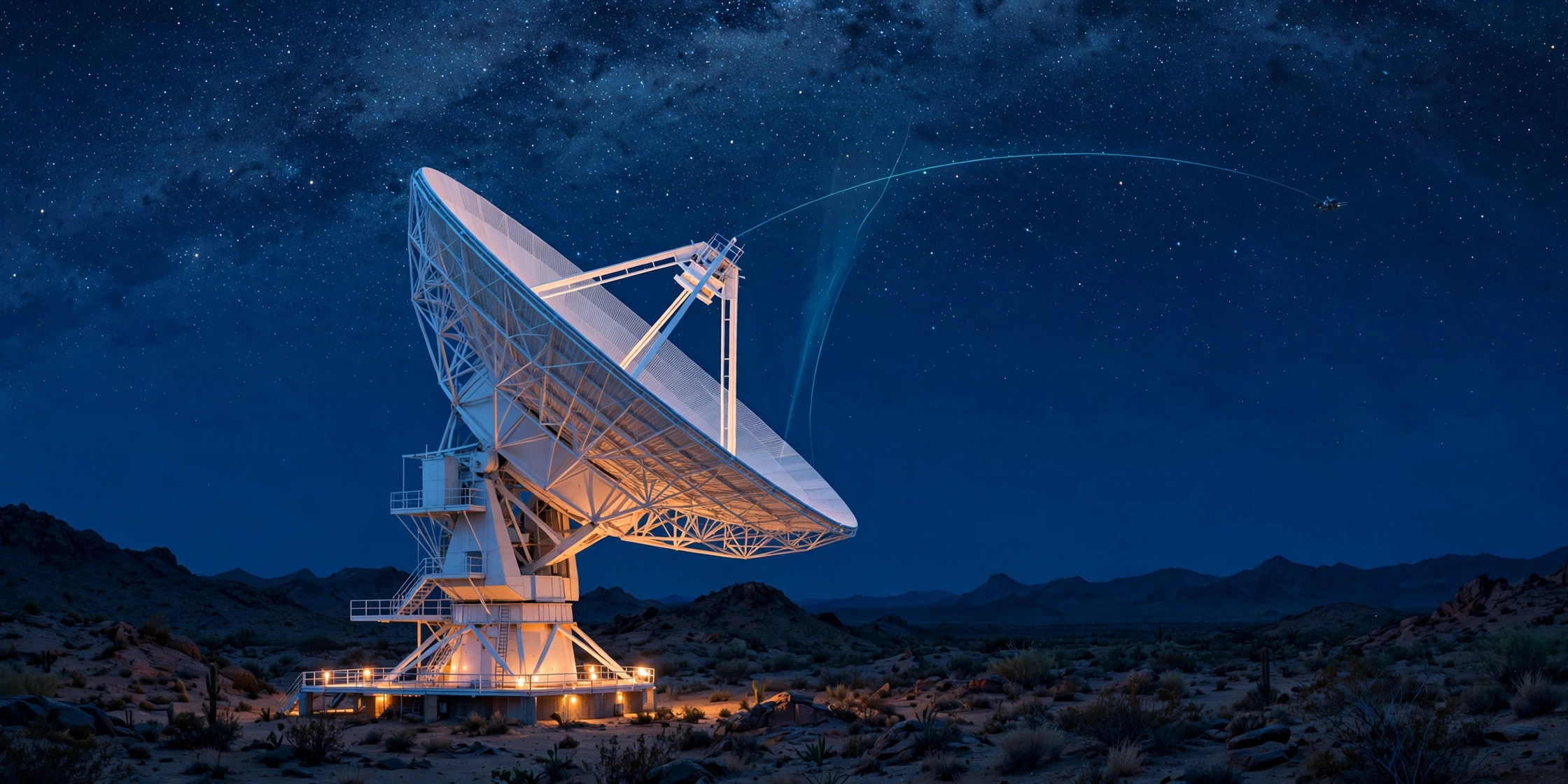
The network has three complexes. One sits in the Mojave Desert near Barstow, California. One sits near Madrid, in Spain. One sits at Tidbinbilla, southwest of Canberra, in Australia. They are spaced roughly 120 degrees apart in longitude, which means that as Earth turns, a spacecraft in deep space is always above the horizon at one of them. A dish in California hands a spacecraft to a dish in Spain, which hands it to a dish in Australia, and the conversation never drops.
NASA built the network in 1963, at the start of the Apollo era, and the Jet Propulsion Laboratory in Pasadena has run it ever since. The sites were put in bowl-shaped, semi-mountainous terrain to shield the dishes from radio interference, because the signals they listen for are vanishingly weak. The operations centre at JPL coordinates the whole thing, routing commands out and data back to the teams that own each spacecraft.
There is no backup network. Every deep-space mission NASA flies depends on these three sites.
The giants and the workhorses
Each complex has one 70-metre dish, the largest and most sensitive antennas NASA owns. There are three of them: Deep Space Station 14 at Goldstone, Deep Space Station 43 at Canberra, and Deep Space Station 63 at Madrid. They were built as 64-metre dishes and widened to 70 metres between 1982 and 1988, to give them the sensitivity needed for Voyager 2’s encounter with Neptune. A 70-metre dish weighs nearly 7.2 million kilograms, and its reflecting surface is held accurate to within a centimetre across 3,850 square metres, because the surface has to stay true to a fraction of the wavelength it receives.
The daily work falls to the 34-metre dishes. Each complex has several, and the newest ones use a beam-waveguide design that sends the radio signal down mirrors into a climate-controlled room below ground, instead of mounting the sensitive electronics on the moving dish. That makes them easier to maintain, and it lets one dish work across several frequency bands, so it can talk to many different spacecraft instead of being built for one.
One dish has a job no other antenna on Earth can do. Deep Space Station 43 at Canberra is the only dish with a transmitter powerful enough, broadcasting on the right frequency, to send commands to Voyager 2. The probe is heading south, below the celestial equator, and Canberra is the only station that can reach it. When DSS-43 went down for 11 months of upgrades, the team had to plan around the gap, because nothing else could fill it.
The dishes can also work together. Four 34-metre antennas, arrayed, can match the collecting power of a single 70-metre dish. That trick matters when a signal is at its faintest, and it is how the network has kept Voyager 1 in contact. NASA’s inspector general reported that it now takes more than 22 hours of antenna time, across five giant dishes, to pick up Voyager 1’s signal and bring its science data home.
A day for a signal to arrive
On November 18, 2026, Voyager 1 became the first human-made object to reach one light-day from Earth. NASA announced the milestone the next day. The probe crossed the mark at 2:16 a.m. Pacific time, about 16.1 billion miles out, or 25.9 billion kilometres. Light, and therefore every radio signal, now takes 24 hours to travel between the probe and Earth. A command sent from a DSN dish reaches Voyager 1 tomorrow. If the probe answers at once, the reply arrives the day after that. One question and one answer takes two days.
The probe is still moving away at roughly 38,000 miles per hour. It was launched on September 5, 1977, and it has been travelling for more than 49 years. Voyager 2, its twin, is behind it and is not expected to reach one light-day until 2035.
Linda Spilker, the Voyager project scientist at JPL, put it plainly when the milestone arrived. “Even traveling at the speed of light, signals now take 24 hours to reach the spacecraft and 24 hours to reach us.”
That delay shapes everything about flying the Voyagers. There is no joystick. Every command is written, checked, sent, and then the team waits a day to see whether it worked. When Voyager 1 stopped sending data on November 14, the engineers could not ask the spacecraft what was wrong and get an answer the same day. They had to read the carrier signal, work out what was still alive, and send instructions they would not know had worked until two days later.
Who gets the dishes
More than 40 spacecraft rely on the network, and there is not enough antenna time to give every mission what it asks for. Planning for a busy period typically starts 12 to 15 weeks ahead, according to JPL’s Deep Space Network project manager, Michael Levesque. Events such as launches and landings need constant contact, so those get booked first. The rest is negotiated. Mission managers talk to each other and to the DSN schedulers, months in advance, and trade hours around the calendar.
There is no standing priority list. The one exception is safety: spacecraft carrying people take precedence over everything else. Beyond that, it is a negotiation, and the negotiation often fails. NASA’s inspector general found that over five years, missions including Mars Odyssey and Voyager 2 received between 8,500 and 15,000 fewer hours of tracking time than they had asked for. When a mission loses hours, data can be lost with them.
The pressure is easy to see in one number. Artemis I, the uncrewed test flight around the Moon in 2022, needed more than 900 hours of DSN time over 25 days. The crewed flights that follow will need more, and every two years the Artemis missions will share the sky with the network’s heaviest users, including the Perseverance rover on Mars and the James Webb Space Telescope.
Anyone can watch the queue. NASA runs a public page, DSN Now, that shows which spacecraft each dish is talking to at any given moment. On a quiet day, most of the dishes are busy.
New steel, and a dish out of service
The network is growing, slowly. On August 3, 2026, a new 34-metre dish, Deep Space Station 23, began operations at Goldstone, its first job tracking the Chandra X-ray Observatory. The ribbon-cutting followed on August 25. Construction began in February 2020, and the 133-ton steel framework that carries the reflector was lifted into place in December 2024. DSS-23 is the fifth antenna at Goldstone and the fifth of six new dishes in the Aperture Enhancement Project, a modernisation programme NASA started in 2009. The sixth and last, Deep Space Station 33, is due to come online at Canberra in 2029, which will bring the network’s total of 34-metre dishes to 13.
The new dish arrived at a bad moment. Goldstone’s 70-metre dish, DSS-14, has been out of service since September 16, 2025, when it over-rotated while tracking the Juno spacecraft at Jupiter. The turn stressed the cabling and structural supports, and damaged hoses in the fire-suppression system flooded the base. NASA’s investigation blamed a combination of software weaknesses and human error, on top of a hydraulic limit system that had failed without anyone noticing. The agency classified it as a Type A mishap, the most serious category, and put the repair bill at $4.1 million to $4.6 million. The dish will stay offline through repairs and a maintenance and upgrade programme already scheduled, and NASA does not expect it back before October 2028.
That leaves two 70-metre dishes carrying the work of three, while the demand keeps rising. The network has kept more than 40 missions in contact through it, and the new dish at Goldstone helps. The distance to Voyager 1 is unchanged, and the signal still takes a day to arrive.
Related: Voyager 1’s data glitch, one light-day out, what is wrong with the probe, and whether NASA can fix it from 25 billion kilometres away.
Sources: NASA (Aug 25, 2026 — DSS-23 began operations Aug 3 tracking Chandra, fifth of six new dishes, DSS-33 due at Canberra in 2029, 13 total 34-metre dishes); NASA (how the network supports the agency’s missions); NASA (Jun 5, 2026 — DSS-14 mishap: Sep 16, 2025 over-rotation tracking Juno, software weaknesses and human error, $4.1–$4.6 million, offline to October 2028, Type A); NASA Office of Inspector General (capacity: more than 22 hours of antenna time for Voyager 1, missions short 8,500–15,000 hours); NASA Jet Propulsion Laboratory (the network looks to the future); Smithsonian Magazine (Nov 18, 2026 — one light-day milestone, 5:16 a.m. EST, about 16 billion miles, 37,844 mph); Wikipedia (Deep Space Network — dish history and specifications); Wikipedia (list of antennas in NASA’s Deep Space Network).
Last verified November 28, 2026.
Related Stories
FAA System Failure Grounded Flights Nationwide: What Broke and What It Means
The FAA stopped every US departure on 13 November 2026 after a new router flooded its legacy network.
Read
Silksong Sea of Sorrow: What Team Cherry’s ‘Cherry Time’ Presentation Could Finally Reveal
Team Cherry's "Cherry Time" airs Friday, November 27, with a Sea of Sorrow update.
Read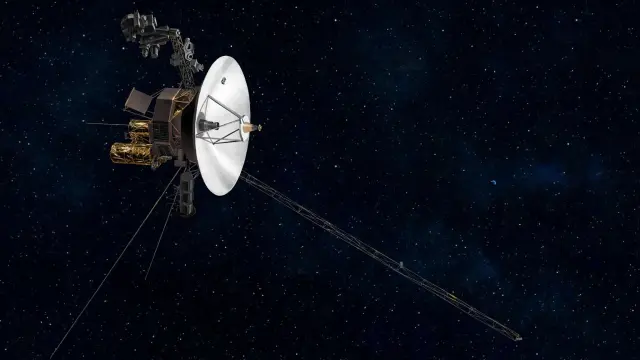
Voyager 1 Data Glitch: What’s Wrong and Can NASA Fix It?
What happened: The Voyager 1 data glitch began November 14, days before the probe crossed one light-day from Earth.
Read
VPN for Streaming: Why Blocks Happen and What Actually Fixes Them
How streaming services spot VPN traffic, the fix ladder to work through in order, and the honest limit no provider can promise past.
Read
NVIDIA RTX Spark Laptops Explained: Should You Buy One?
NVIDIA's new laptops put up to 128GB of unified memory in a Windows machine built to run AI locally.
Read