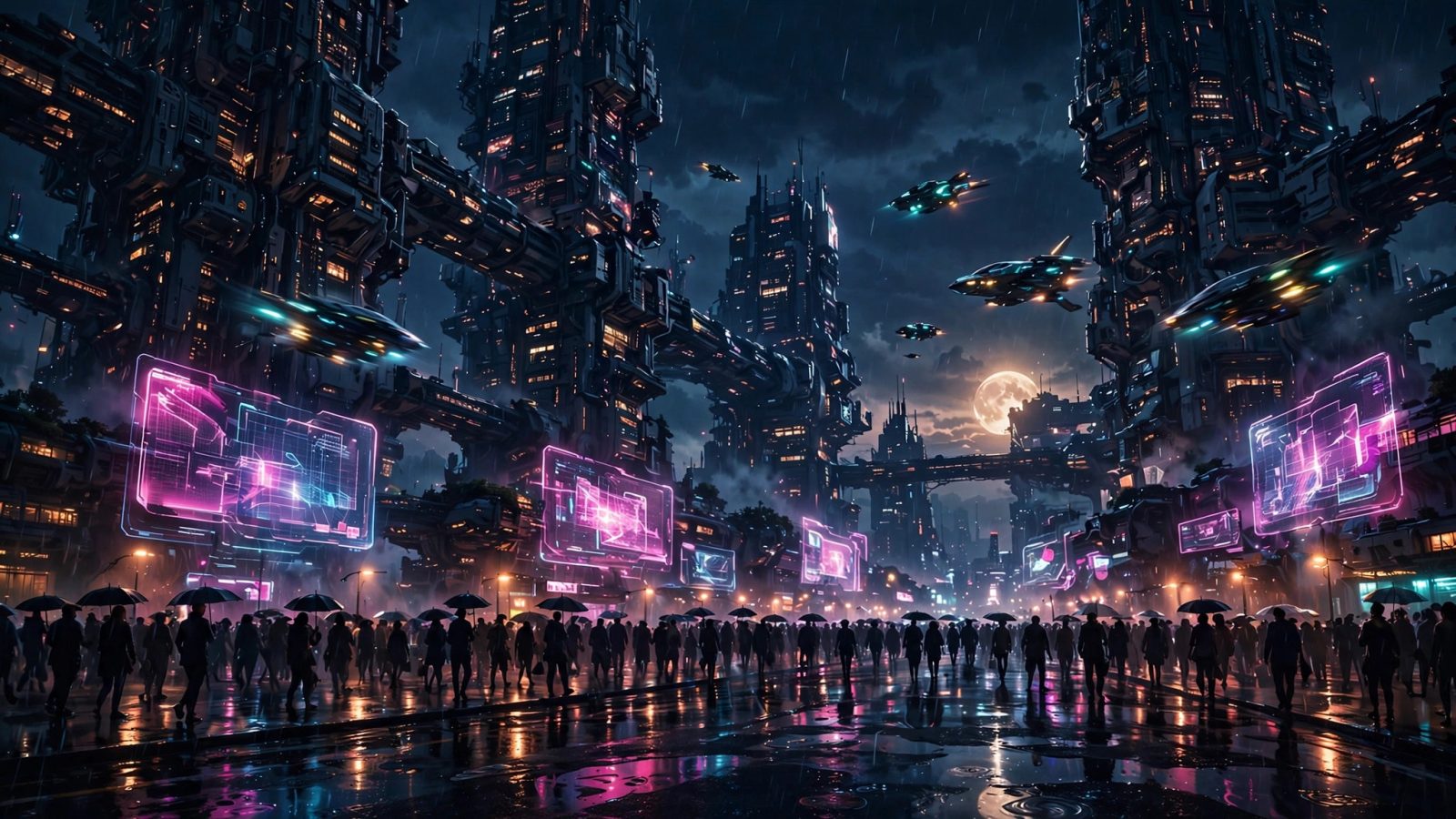
CD Projekt Red’s co-CEO has clarified what the studio wants from the upcoming live-action Cyberpunk 2077 film: a brand-new story set in Night City, not a retelling of the game’s. It is the only choice that could work — and the studio already proved the model with Edgerunners.
In brief
- CD Projekt Red says the Cyberpunk 2077 movie won't recreate the game — it's a new Night City story. What that means for the film and gamers.
- What we actually know about the film: Let's separate the confirmed from the rumored.
- Why V's story can't be adapted: Here is the part the quote-rewriters are missing.
- The Edgerunners proof: The good news is that CDPR already ran this experiment, and it worked.
- What a "new Night City story" unlocks: An original story set in the Cyberpunk universe is not a limitation — it is the only version of this film that has creative room to breathe.
The biggest gaming franchise of the decade is getting a movie, and the studio behind it has just ruled out the thing most fans assumed the movie would be. CD Projekt Red co-CEO Michal Nowakowski said this week that the live-action Cyberpunk 2077 film in development with Paramount Pictures will not adapt the game’s story. “At this point, we can only say that we definitely don’t want to make a film adaptation of the game,” Nowakowski told Polish outlet PAP Biznes. “We want to tell a story in the world of Cyberpunk, but it won’t be a one-to-one translation of the game’s story.”
The quote, reported by Polygon and ScreenRant this week, answers the first real question about a project announced on October 8 with almost no details attached. And it is good news — not a dodge. Anyone who has finished Cyberpunk 2077 knows why: the game’s story cannot survive being translated.
What we actually know about the film
Let’s separate the confirmed from the rumored. Confirmed, via the original Deadline-sourced announcement: Paramount Pictures is developing a live-action Cyberpunk 2077 feature film. CD Projekt Red is a co-producer, keeping creative involvement as the property moves to cinema. Transformers and G.I. Joe producer Lorenzo di Bonaventura is attached to produce, bringing exactly the track record you would expect for a project that needs to render dense urban sprawl, cybernetic body modification, and corporate warfare without losing the human stories underneath.
Beyond that: nothing is locked in. No director. No screenwriter. No cast. No production start date. The project is at a very early stage — the Nowakowski quote is the first substantive creative statement either company has made since the announcement.
The commercial logic is not hard to see. Cyberpunk 2077, which launched in December 2020, has sold more than 40 million copies worldwide, with its Phantom Liberty expansion at 15 million. Night City is a major global franchise, and Paramount is assembling a full slate of mature gaming adaptations — a Call of Duty feature and a Street Fighter film sit alongside this one in development. For Paramount, a recognizable dystopian universe with a built-in audience is exactly the kind of bet studios are making now.
Why V’s story can’t be adapted
Here is the part the quote-rewriters are missing. The game is about a mercenary called V who gets reluctantly implanted with a biochip carrying the engram — a digitized consciousness — of Johnny Silverhand, the legendary rockstar terrorist played by Keanu Reeves. The two must separate from each other, and save V’s life, by confronting the Arasaka Corporation, the megacorp that functions as the city’s de facto ruler. It is a great story. It is also structurally unfilmable, for three reasons that all point the same way.
First, V is not a character in the way movies need characters. V is the player’s build: male or female, corpo or street kid or nomad, stealthy or guns-blazing, merciful or ruthless. The game’s story branches around choices that are hours apart. A film adaptation would have to pick one V — and instantly alienate every player whose V was different. This is the translation problem every RPG adaptation faces, and Cyberpunk’s version is extreme.
Second, Johnny Silverhand is Keanu Reeves, and there is no guarantee Reeves will reprise the role. As ScreenRant noted this week, without Reeves, the emotional core of the game’s story — the uneasy, eventually tender coexistence of V and Silverhand — cannot be reproduced. With him, the film would still have to compress a hundred-hour relationship into two. It is a casting problem and a pacing problem at once.
Third, compressing a branching, choice-driven narrative into a fixed two-hour plot guts the thing that made the game work. The game’s best moments are emergent: the player chose them. A film that recreates V’s path to Arasaka Tower would feel like watching someone else’s playthrough — the exact experience every gamer dreads.
Nowakowski’s statement reads, on this evidence, less like caution and more like clarity. The studio knows the game it made.
The Edgerunners proof
The good news is that CDPR already ran this experiment, and it worked. Cyberpunk: Edgerunners, the Netflix animated series made with Studio Trigger — the studio behind Kill la Kill and Little Witch Academia — told an original story with new characters in the world of the game rather than adapting V’s arc. It was not a footnote to the franchise; it was one of the most acclaimed game-adjacent series ever made, and it sent a wave of players back to Night City. A second season arrives October 20, days from now.
The Edgerunners model is the answer to the adaptation question: Night City is the IP, not V. The city’s texture — the corps, the fixers, the braindance lounges, the corpo plazas and the Nomad badlands — supports stories the game never touched. Edgerunners proved an audience will show up for new faces in a familiar dystopia. The live-action film is now formally following the same playbook, with a much bigger budget and a studio that specializes in exactly this kind of world-building franchise work.
What a “new Night City story” unlocks
An original story set in the Cyberpunk universe is not a limitation — it is the only version of this film that has creative room to breathe. Consider what the game established and barely explored.
The corporate wars: the game gestures at conflicts between megacorps — Arasaka, Militech, Biotechnica — that reshape whole districts, then leaves them as background. A film could put a corpo conflict at the center, told from inside the towers the game only lets you raid. The 2077 game is mercenary-eyed; a film could be corpo-eyed, or fixer-eyed, or civilian-eyed. Each is a different genre wearing the same neon.
The tabletop lore: Cyberpunk’s world predates the game by decades. The tabletop sourcebooks hold thirty-plus years of Night City history — the Fourth Corporate War, the Night City Holocaust, the gang generations — that the game samples but never centers. An original film can mine that depth without contradicting anything a player experienced, because the game’s story never claimed those corners.
New technology, new crews, new districts: Night City’s map is huge, and most films set there will never need to revisit V’s apartment or Afterlife. The universe is big enough to hold a dozen stories. The mistake would have been to shrink it down to one playthrough.
There is also a production argument nobody is making. di Bonaventura’s challenge, as undercodenews framed it, is translating a world built around player choice and branching narrative into a story that works without interactive gameplay. An original story is his native territory — the Transformers and G.I. Joe films were world adaptations, not plot transcriptions. Hiring him for a new story makes sense; hiring him to re-enact a game campaign would not have.
What this signals for game-to-film
Step back and the pattern is clear. The successful game adaptations of recent years — The Last of Us, Fallout, Edgerunners — treat the world as the property and the story as new material. The failures were the ones that tried to compress a playable narrative into a watchable one, losing both the agency that made it a game and the structure that makes a film. CD Projekt Red choosing the Edgerunners route for its first theatrical outing is the industry learning in public.
It also says something about where the franchise goes next. Cyberpunk 2 is in development, and the studio’s posture — protect the canon, expand the world, don’t retell the game — suggests a franchise strategy built on Night City as a platform: games, animation, film, each adding stories the others can’t. The movie doesn’t compete with anyone’s playthrough. That is precisely why it might be worth watching.
What this means for you
- Don’t expect V or Johnny Silverhand. The film is officially a new story in Night City, not a retelling of the game’s campaign — set your expectations for new characters, not a Keanu reunion.
- The Edgerunners model is the template. An original Night City story with new characters already worked on Netflix, and season 2 arrives October 20 — watch it to calibrate what the film is aiming for.
- No dates yet — ignore every rumor. No director, writer, cast, or release window is confirmed; treat any “leaked” title or date as speculation until Paramount or CDPR says otherwise.
- If you haven’t played, this is a good entry point. The film won’t spoil the game (it won’t retell it), and Phantom Liberty remains the best way into Night City on current hardware — read our breakdown of Sony’s three PlayStation 6 models and NVIDIA’s RTX Spark laptops for local AI if you’re weighing what to play the next chapter on.
Related coverage: Cyberpunk: Edgerunners 2: Release Date, Time, and Story Guide
Sources
- Wccftech — the Cyberpunk 2077 film will not be a direct adaptation, CDPR CEO confirms the Paramount deal
- Particle — CD Projekt Red confirms Paramount will make the live-action Cyberpunk film

Shoaib Hassan
Shoaib Hassan is the founder and editor of AuTechWire, an independent technology publication covering broadband, mobile networks, privacy, startups, and consumer tech.
Related Stories

Apple’s October 28 Event: The First Touch-Screen MacBook Is Finally Coming
In brief Apple confirmed a second October product event — "Pro and tell," held in Los Angeles on…
Cyberpunk 2077 Update 2.5: Everything in the Edgerunners Patch (and What Leaked Early)
In brief CD Projekt Red announced Update 2.5 on October 20, 2026: it goes live October 22 for…
GTA 6 Pre-Orders Hit 6.45 Million — $630 Million Before Launch
One month before launch, Grand Theft Auto VI has already pre-sold an estimated 6.45 million copies — roughly…