The October 2026 GameGPU reports revived the PS6 three-model rumor. Almost none of it is new — but a few details are, and one of them got publicly disavowed by the original leaker. Here’s the full triage.
In brief
- PlayStation 6 three models rumor triage: what the Oct 14 GameGPU reports add to April's Moore's Law is Dead leak, and whether to wait or buy a PS5 now.
- How did the three-model rumor start?: The three-model story began in April 2026 with a video from YouTuber and hardware leaker Moore's Law is Dead (MLID), who has a track record of accurate hardware leaks.
- What's actually new in the October reports?: GameGPU's October 14, 2026 report (published October 13 at 21:03 UTC) describes the same three configurations: a flagship desktop console, a fully fledged portable sys…
- The triage: which claims are new, which are recycled?: The pattern: the October wave added structure (the Lite-as-media-box idea, explicit docking framing) but no new sourcing, and the most technical-looking details arrive…
- PlayStation 6 Three Models: What Each One Is Supposed to Be: With the sourcing sorted, here's the alleged lineup as the combined April-plus-October reporting describes it.
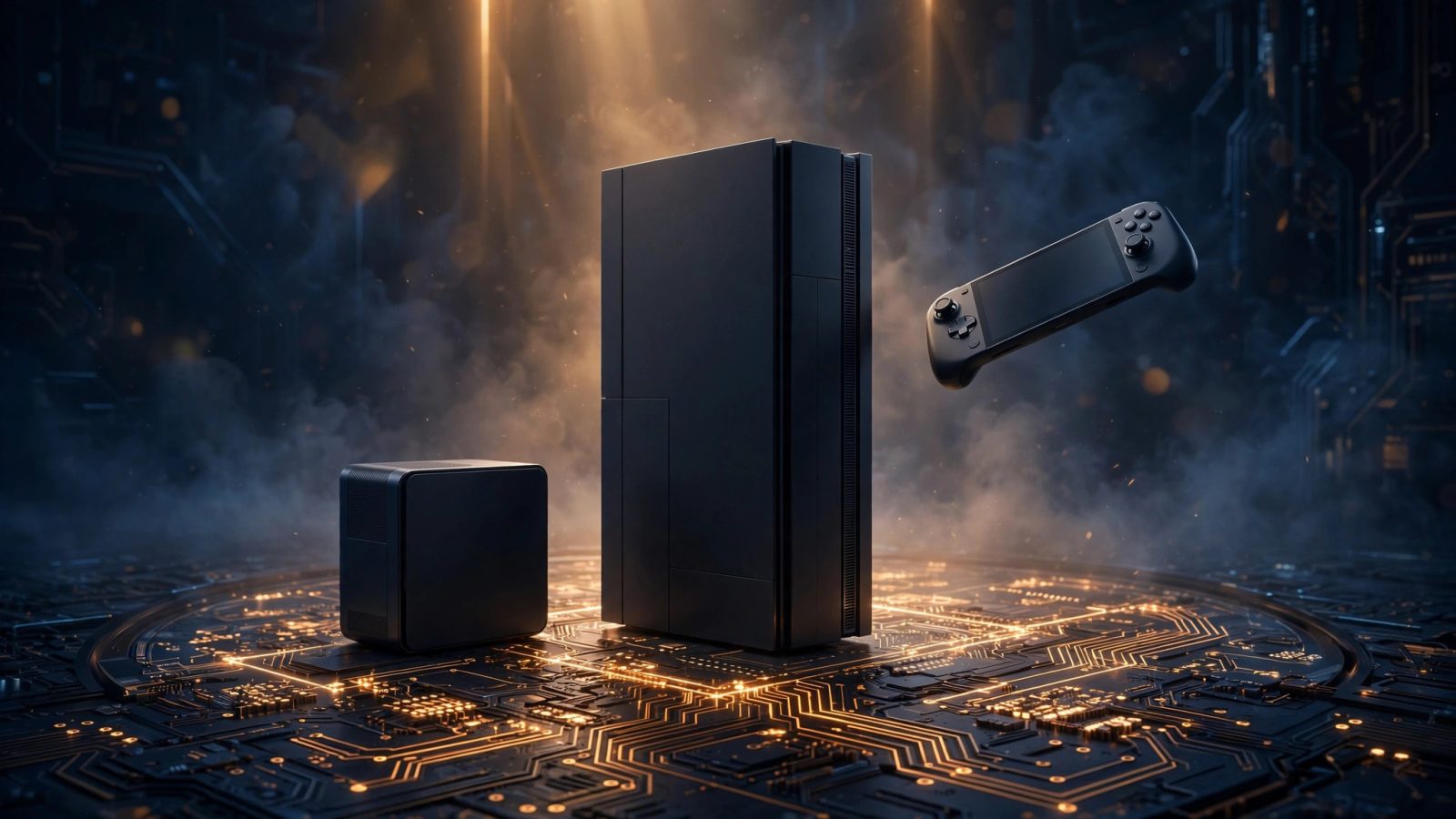
The PlayStation 6 three models rumor is back in the headlines. On October 14, 2026, hardware outlet GameGPU reported that Sony is planning three PlayStation 6 configurations: a flagship desktop console, a dockable handheld, and a budget PS6 Lite. The honest answer, up front: the three-device structure comes straight from Moore’s Law is Dead’s April 2026 leak, the October reports add almost no verifiable new information, and one of the most-shared “new” details was disavowed the same day by the leaker it was attributed to.
Nothing here is confirmed. Sony has announced no PS6 name, specs, price, or release date — that fact comes first, because the rest is sourcing discipline. Below is a claim-by-claim triage of what’s actually new in the October reports, what was recycled from April, and what you should actually do with the information.
How did the three-model rumor start?
The three-model story began in April 2026 with a video from YouTuber and hardware leaker Moore’s Law is Dead (MLID), who has a track record of accurate hardware leaks. According to coverage of that video by TechRadar, dev.ua, and GamesHub, MLID claimed Sony was preparing three devices for a simultaneous 2027 launch: a full PS6 powered by an AMD “Orion” chip, a budget PS6 S (or Lite) powered by an AMD “Canis” chip, and a portable companion handheld also built on Canis silicon.
MLID also attached estimated prices to the three devices. This is the part most October coverage glosses over: TechRadar explicitly emphasized that these were not leaked internal Sony prices — they were MLID’s own forecasts based on component costs, memory shortages, and tariff policy at the time. The estimates were PS6 S at $349–$549, the handheld at $499–$699, and the flagship at $699–$999.
Two structural claims from April matter for everything that follows. First, the budget console and the handheld would share the same Canis chip, which would let Sony spread component costs across two products. Second, the handheld would play games natively — unlike the PlayStation Portal, which is a streaming-only peripheral priced at $249.99. A native handheld was the genuinely surprising part of the April leak.
What’s actually new in the October reports?
GameGPU’s October 14, 2026 report (published October 13 at 21:03 UTC) describes the same three configurations: a flagship desktop console, a fully fledged portable system that runs games natively and gets faster when docked, and an entry-level “PS6 Lite” desktop. It adds one structural idea not present in April’s reporting: the Lite model would allegedly reuse the handheld’s silicon or a “PSP3” architecture as a compact home media box without its own screen or battery.
But here’s the triage result that matters most. Read the GameGPU piece directly and you’ll notice what’s missing: no codenames (no Orion, no Canis), no prices, and only vague sourcing — “semiconductor industry insiders and analysts.” Everything specific in the October wave — the chip details, the 540p internal rendering claim, the price tiers — traces back to the April MLID material or to earlier GameGPU reporting on the Canis handheld, not to new information.
And then there’s the disavowal. According to a sourcing timeline compiled by tech-insider.org, on the same day the October reports circulated, hardware insider Kepler_L2 — the most credible of the Canis leakers, whose earlier reporting underpins much of the handheld spec sheet — publicly disavowed the circulating spec sheet, saying he had published no new PS6 handheld specs “in months.” IBTimes UK re-attributed the circulating spec sheet to GameGPU rather than Kepler_L2. In other words: the “new” handheld specs were an old spec sheet with a new name attached, and the original source said so publicly.
TweakTown added its own caution, noting that GameGPU “doesn’t carry the same track record as more established leakers like Kepler_L2 or Moore’s Law Is Dead.” That doesn’t mean the report is wrong — it means it should be weighted accordingly.
The triage: which claims are new, which are recycled?
| Claim | Source | New or recycled? | Confidence |
|---|---|---|---|
| Sony plans three PS6 devices: flagship, budget console, handheld | MLID (April 2026); restated by GameGPU (Oct 14, 2026) | Recycled | Medium — two sources, but both are leaks |
| Flagship uses AMD “Orion” chip; budget + handheld use “Canis” | MLID (April 2026) | Recycled — GameGPU’s Oct 14 report doesn’t name codenames | Low–medium |
| PS6 S $349–$549; handheld $499–$699; flagship $699–$999 | MLID estimates (April 2026) | Recycled — and these were analyst forecasts, not leaked prices | Low |
| Handheld plays games natively, not streaming | MLID (April 2026); restated by GameGPU (Oct 14, 2026) | Recycled | Medium |
| Handheld runs faster when docked (higher clocks/TDP) | GameGPU (Oct 14, 2026) | New-ish — docking was in earlier Canis coverage, but GameGPU ties it explicitly to the three-model plan | Low–medium |
| PS6 Lite reuses handheld silicon as a screenless media box | GameGPU (Oct 14, 2026) | New to the October wave | Low |
| Handheld renders at 540p internally, upscales to 1080p via PSSR 3.0 | GameGPU (via TweakTown/Ground News, Oct 14 wave) | Repackaged — spec-sheet detail from earlier GameGPU reporting, re-attributed; disavowed by Kepler_L2 | Low |
| Canis handheld beats base PS5 when docked via PSSR 3.0 | GameGPU estimates (Oct wave) | GameGPU’s own estimate, not a source claim | Very low |
The pattern: the October wave added structure (the Lite-as-media-box idea, explicit docking framing) but no new sourcing, and the most technical-looking details arrived with a public disavowal attached. Treat the whole wave as one data point, not corroboration — the same claims repeated by more outlets are not independent confirmation.
PlayStation 6 Three Models: What Each One Is Supposed to Be
With the sourcing sorted, here’s the alleged lineup as the combined April-plus-October reporting describes it.
The flagship. Codenamed “Orion” in the April reporting, this is the traditional under-the-TV powerhouse — the direct successor to the PS5. Separate leaks summarized by gamermarkt suggest targets like 4K at 120 FPS with advanced ray tracing, and Kepler_L2 has claimed the Orion APU (spotted in AMD driver code as “ATLite3” per Notebookcheck) was taped out with around 40 TFLOPS of raw compute. Estimated price range: $699–$999.
The PS6 S (Lite). A lower-cost home console comparable to the Xbox Series S, built on the Canis chip. The October report’s distinctive addition: it could be a compact media box reusing the handheld’s silicon, with no screen or battery, aimed at the lowest possible entry price. Estimated range: $349–$549.
The handheld (Project Canis). The most interesting and least certain of the three. The claim is a fully standalone portable — native game execution, not the Portal’s streaming model — that outperforms the Xbox Series S and, when docked with higher clocks, approaches base-PS5-level performance through PSSR 3.0 upscaling. The reported hardware: a 3nm AMD chip with six Zen 6-family CPU cores, 16 RDNA 5 compute units, 24GB of LPDDR5X memory on a 192-bit bus, running at 15–25W. Estimated range: $499–$699.
Two launch configurations may also exist for the flagship — digital-only and disc-based, or digital-only with a detachable drive, extending the approach Sony started with the PS5 Slim’s detachable drive. All prices above are MLID’s April estimates, not Sony figures.
Could three PlayStation 6 models split developers?
This is the question the October coverage mostly skipped, and it’s the one that matters most for game quality. If the rumor is right, developers wouldn’t target one PlayStation 6 — they’d target three very different performance floors, on top of the PS5 and PS5 Pro they’d still be supporting for years.
The precedent is Microsoft’s Xbox Series X/S split, and it’s instructive. The Series S — roughly 4 TFLOPS against the Series X’s 12 — became the floor every Xbox game had to clear, and developers and players debated for years whether it held back ambitious games. A Canis handheld reportedly running at 4.91 TFLOPS in portable mode (GameGPU via TweakTown) would set a floor even lower than the Series S — and critically, one that depends on aggressive upscaling (540p internal rendering, per the same report) to look acceptable on its own screen.
On the optimistic side, Sony has built the tools for this. PSSR — PlayStation Spectral Super Resolution — already exists on the PS5 Pro, and PSSR 3.0 with frame generation is reportedly the cornerstone of the handheld strategy. The PS5 SDK reportedly added a “Smart Delivery”-style feature that could handle targeting multiple devices. And the PS5-to-PS5 Pro split is already a two-target world developers navigate today.
The honest version: a three-device launch would be the most ambitious hardware fragmentation Sony has ever attempted — bigger than the PS5/PS5 Pro split, bigger than the Series X/S split. It only works if the scaling tools genuinely deliver and if Sony enforces a compatibility promise developers trust. The PS Vita is the cautionary tale here: capable hardware, unclear platform status, and developer support that withered. Whether the Canis handheld is a first-class platform or a secondary device is the single most important unanswered question in the entire rumor — and neither the April nor the October reports answer it.
What does the PS5 Pro’s $899.99 price tell you?
Pricing context is where the rumor gets real for your wallet. On April 2, 2026, Sony raised PS5 prices globally — the second increase in under a year. In the US, the standard PS5 went from $549.99 to $649.99, and the PS5 Pro went from $749.99 to $899.99. The Pro has climbed $200 from its $699.99 launch price in September 2024, in less than two years, driven by what Sony’s marketing VP called “continued pressures in the global economic landscape.”
That $899.99 figure reframes MLID’s $699–$999 flagship estimate. When the mid-generation refresh already costs $899.99, a next-generation flagship landing anywhere in the $700s would be genuinely aggressive — and the top end of the estimated range, $999, starts to look like the realistic case. Bloomberg reported in February 2026 that Sony was considering pushing the PS6 debut to 2028 or even 2029 because of the AI-driven memory crisis, with DRAM prices reportedly up 171% year-on-year. Every month of elevated component costs pushes the affordable end of the range further out of reach.
So the price story has two layers: the leaked estimates assume a 2027 world that may not exist, and the confirmed reality is that Sony cannot hold prices on current hardware. If you’re budgeting for a PS6, budget for the top of the range — and budget for the possibility that it arrives later than 2027.
Should you wait for the PS6 or buy a PS5 now?
Here’s the decision frame the rumor press never gives you.
Buy a PS5 now if: you want to play current games — including the option of a gaming-capable PC instead of a console: our explainer on NVIDIA’s RTX Spark laptops covers the new local-AI machines, including how they handle games on Windows on Arm. — including Grand Theft Auto VI, scheduled for November 19, 2026 — on the best available console hardware. The PS6 is, at best, a late-2027 launch with contested timing (MLID says late 2027 for all three devices; Bloomberg says 2028 or 2029 is on the table; PlayStation architect Mark Cerny says next-gen is “still several years away”). Waiting on an unconfirmed rumor means sitting out a year or more of games for hardware that may not exist in the form described. At $649.99 for the standard PS5, you’re buying certainty.
Don’t buy the PS5 Pro as a “PS6 bridge” if price matters. At $899.99, the Pro now costs more than MLID’s low-end estimate for the actual PS6 flagship. That’s a strange place for a stopgap purchase. The Pro makes sense only if you specifically want the best PS5 experience today and accept it may be eclipsed within two years.
Wait if: your current setup still plays what you want, and the handheld specifically appeals to you. A native-play PlayStation handheld has no current equivalent — the Portal streams, the Steam Deck isn’t a PlayStation — so if portable native PlayStation gaming is the thing you actually want, nothing you can buy today satisfies it. Just don’t wait based on the three-model rumor alone: it’s unverified, the timeline is disputed, and the October wave added no new evidence.
The one thing not to do: make a purchase decision based on any single leak report. The October wave looked like new information and turned out to be mostly repackaging with a disavowal attached. That pattern will repeat. Decide on confirmed facts — prices, dates, specs Sony actually announces — and treat everything else as entertainment.
What this means for you
- The October reports are mostly a re-run of April. The three-device structure, the codenames, and the price tiers all originate with Moore’s Law is Dead’s April 2026 leak. GameGPU’s contribution is structural framing (docking, the Lite-as-media-box idea), not new sourcing.
- The most technical “new” claims were disavowed. Kepler_L2 publicly said he published no new handheld specs, and the circulating spec sheet was re-attributed to GameGPU — which TweakTown notes lacks the track record of established leakers. Weight it accordingly.
- A three-model launch would be Sony’s biggest fragmentation bet ever. The developer question — whether the handheld is a first-class platform — is unanswered and matters more than any spec sheet.
- The PS5 Pro at $899.99 resets your price expectations. If the mid-gen refresh costs that much, budget for the top of any PS6 price estimate, and take the 2027 timeline with skepticism given the memory crisis.
- Buy on confirmed facts, not leaks. A PS5 today is certain hardware with a certain price and a certain game library. Everything about the PS6 is a rumor with a contested timeline.
Sources
- Tech Insider — PlayStation 6 release window, leaked Orion specs and the Canis handheld reports
- Insider Gaming — PS6 reportedly costs $200 less to develop than the next Xbox
Related coverage
- H-1B Salary Threshold 2026 Bill: What the $140,000 Proposal Does
- NVIDIA RTX Spark Laptops Explained: Should You Buy One?
- Cyberpunk 2077 Movie: CD Projekt Red Confirms a New Night City Story
- PS6 Price Crisis: Memory Alone Now Costs Sony $680
- Game Pass Loses 8 Games on Oct 31: Which Are Worth Your Time

Shoaib Hassan
Shoaib Hassan is the founder and editor of AuTechWire, an independent technology publication covering broadband, mobile networks, privacy, startups, and consumer tech.
Related Stories

Apple’s October 28 Event: The First Touch-Screen MacBook Is Finally Coming
In brief Apple confirmed a second October product event — "Pro and tell," held in Los Angeles on…

Cyberpunk 2077 Update 2.5: Everything in the Edgerunners Patch (and What Leaked Early)
In brief CD Projekt Red announced Update 2.5 on October 20, 2026: it goes live October 22 for…

GTA 6 Pre-Orders Hit 6.45 Million — $630 Million Before Launch
One month before launch, Grand Theft Auto VI has already pre-sold an estimated 6.45 million copies — roughly…