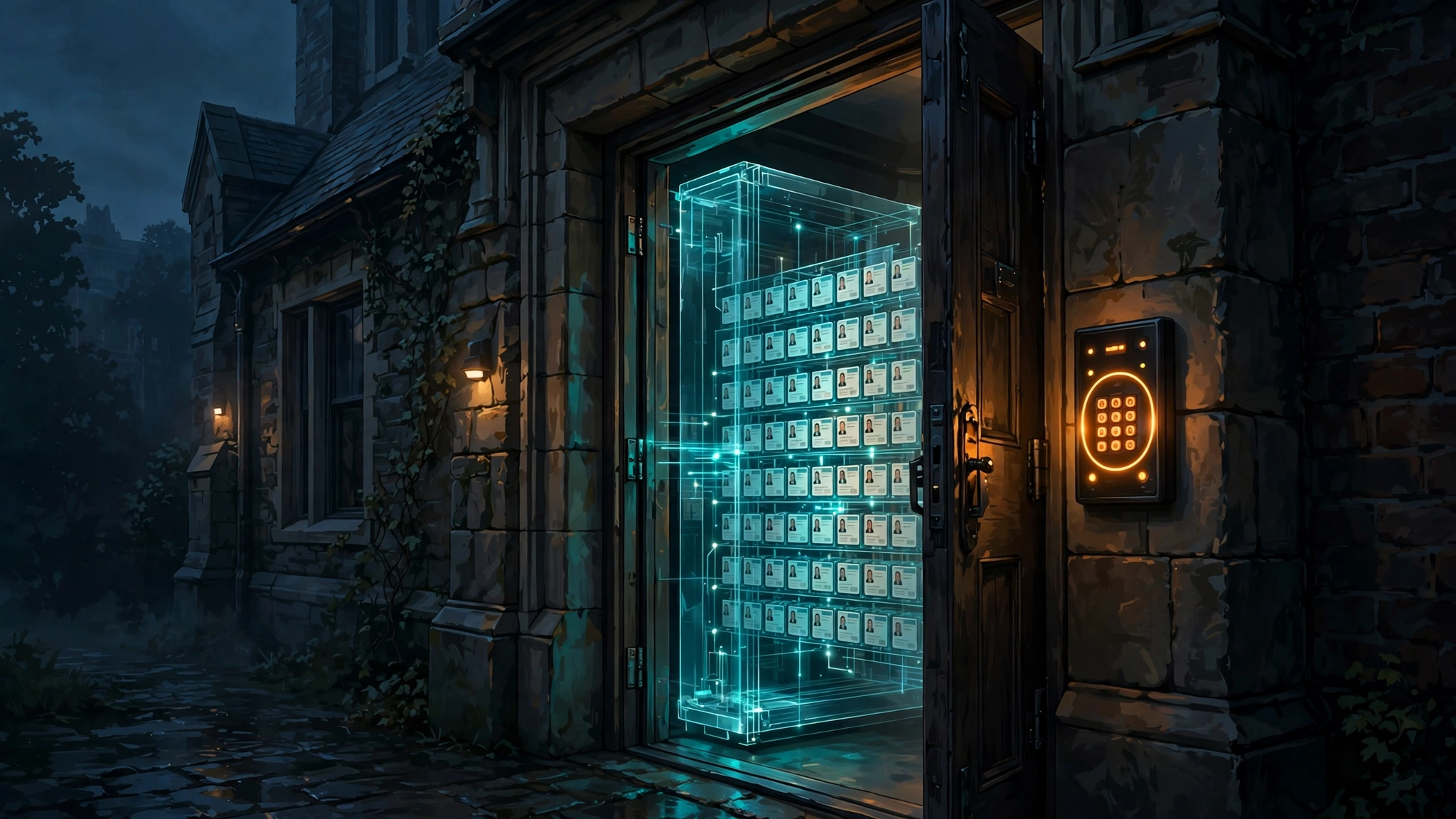
University of Copenhagen Breach: 525,000 People, and the Test System That Held Their Data
In brief
- Hackers accessed a University of Copenhagen test environment holding data on 525,000 people, including national ID numbers. Then 20,000 door PINs turned it physical.
- The exposed data includes full names, Danish national identity numbers (CPR numbers), work and home telephone numbers, and personal email addresses.
- The university detected the intrusion on Tuesday, October 20, 2026, and disclosed it on Friday, October 23. It says access has since been closed and there is no indication that systems supporting day-to-day operations were reached.
- In a further update on Sunday, October 25, the university revealed that ID card PINs belonging to approximately 20,000 students and employees had also been compromised — turning a data breach into a physical-security incident that forced temporary restrictions on access to critical campus locations.
- The incident has been reported to the Danish Data Protection Agency (Datatilsynet). The university is still working to establish the full extent of the incident and has not published a breakdown of who the 525,000 people are.
What happened, on the confirmed timeline
The timeline matters here because it shows a breach discovered, contained, and then widened by a second disclosure — a pattern that is common and worth understanding.
The university detected the intrusion on Tuesday, October 20, 2026. It disclosed the breach publicly on Friday, October 23, saying hackers had accessed a test environment and that information on approximately 525,000 individuals may have been exposed. The university said it had closed the attackers’ access and was working intensively to establish the full extent of the incident and prevent further attacks.
Then, on Sunday, October 25, came the update that changed the shape of the story: PIN codes for approximately 20,000 physical ID cards had also been compromised. Those cards open campus buildings and sensitive laboratory areas. The university said it had delayed disclosing the PIN detail until replacement codes were distributed, for security reasons. Access to certain critical locations had been temporarily restricted as a precaution on Friday; those locations reopened as new codes were issued.
Two things are notably absent from the university’s statements so far. It has not named an attacker or described the method of entry, and it has not published a breakdown of which categories of people — current students, former students, staff, researchers, external partners — make up the 525,000. Until it does, anyone with any connection to the university should assume they could be among them and act accordingly, rather than waiting for a personalized notification that may take weeks.
Why a CPR number matters more than an email address
A CPR number is Denmark’s national identity number, used for everything from healthcare to banking — the Danish equivalent of a US Social Security number. That is why this breach matters more than a leaked email list.
An email address can be changed, filtered, or abandoned. A national identity number follows a person for life and is the key that unlocks other identity checks. Combined with a full name, phone numbers, and a personal email address, a CPR number gives an attacker the raw material for convincing phishing, identity fraud, and account-takeover attempts that can persist for years. The exposure window is not the week of the breach; it is the indefinite future, because the data does not expire.
This is also why the university’s report to Datatilsynet, Denmark’s data protection authority, matters. Under GDPR, a breach involving national identity numbers at this scale triggers formal notification duties and regulatory scrutiny of how the data came to be in the compromised system in the first place. The regulatory question and the security question are the same here: why did a test environment hold production-grade identity data on half a million people?
The real lesson: test environments are production systems in disguise
The most important sentence in the university’s statement may be the one that sounds reassuring: the attack hit “one of the university’s test environments,” not systems that run daily operations, and there is no indication that daily-operations systems were accessed or university activities disrupted.
That is true as far as it goes, and it is also the point. A test environment that holds real personal data on 525,000 people is not a low-risk system, whatever its label says. Test and staging systems routinely receive copies of production data for realistic testing, and then receive weaker access control, less monitoring, and less patching urgency than the production systems they mirror — because they are classified as non-production. Attackers know this. A copy of production data with staging-grade security is, from the attacker’s perspective, simply production data with an easier door.
Every organization runs some version of this setup: a staging database seeded from production, a test bucket with a snapshot of customer records, an analytics environment fed by a nightly production export. The Copenhagen breach is a concrete demonstration of the failure mode. The controls that matter — data minimization (does the test system need real identity numbers, or would masked data work?), access logging, credential hygiene, and network segmentation from production — are exactly the controls that get deferred for test systems because “it is only test.”
The practical test for any IT team reading this: list every system holding a copy of production personal data, regardless of its environment label, and apply production controls to all of them. If a system cannot justify holding real identity data, replace it with synthetic or masked data. The label on the server is not a security control.
When a data breach unlocks doors
The PIN disclosure deserves separate attention because it crosses a line most breach stories never reach: from digital identity theft to physical access.
ID card PINs for approximately 20,000 staff and students open buildings and sensitive laboratory areas. A stolen PIN, unlike a stolen password, cannot be reset by the victim alone — it requires the institution to reissue codes and physically restrict locations in the meantime, which is what the university did. The delay in disclosing the PIN compromise until replacements were ready was a defensible security call: announcing that 20,000 door codes were compromised before changing them would have advertised an open door.
But the incident exposes a design weakness worth noting for any institution: a single compromised dataset that yields both identity data and physical-access credentials multiplies the response. The digital response (notifications, monitoring, regulator reports) and the physical response (lockdowns, reissued codes, restricted areas) have to run simultaneously, under different teams, on different timelines. Organizations that keep their physical-access credential data in the same environment as their identity data should reconsider that coupling.
For affected students and staff, the immediate steps are concrete: use the replacement PIN when issued, do not reuse the old one anywhere, treat any message referencing the breach as a potential phishing attempt, and watch for identity-fraud signals — unexpected account activity, unfamiliar credit or benefits correspondence, and contact from anyone claiming to be the university asking for credentials. The university will not ask for passwords or PINs by email.
A pattern across Danish universities
The Copenhagen breach is the third major cyberattack on a Danish university in less than 30 days, according to October 27 coverage. Aarhus University reported a hacking attempt earlier in the same week, discovered on a Monday and disclosed on a Thursday, in which attackers tried to access the passwords of 1,700 students and employees; that attempt was discovered and stopped. The Technical University of Denmark was also attacked in the same period.
No connection between these separate cases has been established, and they should not be presented as a coordinated campaign without evidence. But the clustering is still meaningful for defenders: universities are attractive targets because they hold large identity datasets, run open networks by design, and operate many semi-autonomous systems — including test environments — under one institutional umbrella. Attackers do not need a campaign to find that pattern; they need only try the same doors at several institutions and see which ones open.
For the sector, the Copenhagen incident is likely to become a reference case in the same way earlier university breaches became cautionary tales: not because the attack technique was novel — no technique has been disclosed — but because the target was a system everyone assumes is low-risk.
What this means for you
- If you have any connection to the University of Copenhagen: assume you could be among the 525,000 until the university publishes a breakdown. Watch for phishing that uses your name, phone number, or CPR-linked details, and use your replacement door PIN when issued.
- If you run test or staging systems: audit every copy of production personal data today, whatever the environment label. Mask or synthesize data where real identities are not needed, and apply production access controls to any system that still holds real data.
- If your institution couples digital and physical credentials: separate them. A breach that yields both identity data and door codes doubles the incident, and the physical response cannot wait for the digital investigation.
- If you are a university IT leader: treat the Danish cluster as a warning, not a coincidence to explain away. Test-environment hygiene and identity-data minimization are now the cheapest risk reductions available.
What is still unknown
The investigation is ongoing, and several material facts are still missing: the attacker’s identity, the method of entry, the full breakdown of affected people, and whether the exposed data has been misused beyond the intrusion itself. The university says it sees no sign that daily-operations systems were reached, but that is a statement about what investigators have found so far, not a final verdict. Coverage that fills these gaps with speculation should be treated as speculation. This draft will need a freshness check at publish time for any new university statement, regulator comment, or misuse report.
Related reading
- Aokigahara Malware Targets ChatGPT, Claude and Cursor Credentials — stolen credentials as the entry point, and the revoke-and-rotate response.
- eMudhra Update: Chrome Drops Its Root Today, What to Do — another October trust-store incident, and what to do when a trusted root goes away.
- Node2Shell in Go: Brotli Flaw Expands to Traefik, Fiber, Iris — how one flaw class spreads across an ecosystem.
Sources
- BleepingComputer, “University of Copenhagen data breach exposes data of 525,000 people,” October 2026: https://www.bleepingcomputer.com/news/security/university-of-copenhagen-data-breach-exposes-data-of-525-000-people/
- NordiskPost, “Another cyberattack at the University of Copenhagen disrupts systems,” October 27, 2026 (PIN update, Aarhus context, no established connection): https://www.nordiskpost.com/2026/10/27/copenhagen-university-second-cyberattack-systems-shutdown/
- PrivacyUnpacked, “University of Copenhagen Hack: What Was Exposed and What to Do,” October 2026: https://privacyunpacked.com/university-of-copenhagen-hack-525000/
- ASUMetech, “Third Major Danish University Cyberattack Within One Month Hits University of Copenhagen,” October 27, 2026: https://asumetech.com/2026/10/27/third-major-danish-university-cyberattack-within-one-month-hits-university-of-co/
Last verified: October 28, 2026.

Shoaib Hassan
Shoaib Hassan is the founder and editor of AuTechWire, an independent technology publication covering broadband, mobile networks, privacy, startups, and consumer tech.
Related Stories

Warp Breach Exposes AI Agent Logs: What Affected Users Should Check
Warp Breach Exposes AI Agent Logs: What Affected Users Should Check In brief Warp says about 1% of…

Mistral’s Large 4 Gives Everyone a Cyber Defense Model — and That’s the Point
Mistral's Large 4 Gives Everyone a Cyber Defense Model — and That's the Point In brief Mistral's Large…
Google’s Gemini 4 Carbon Tops Cybersecurity Benchmarks — but You Can’t Use It Yet
Google's Gemini 4 Carbon Tops Cybersecurity Benchmarks — but You Can't Use It Yet In brief Google's Gemini…