In brief
Five AI-agent attacks confirmed in Switzerland, three on critical infrastructure. Four systems compromised. What the tools do, and 24-hour patching advice.
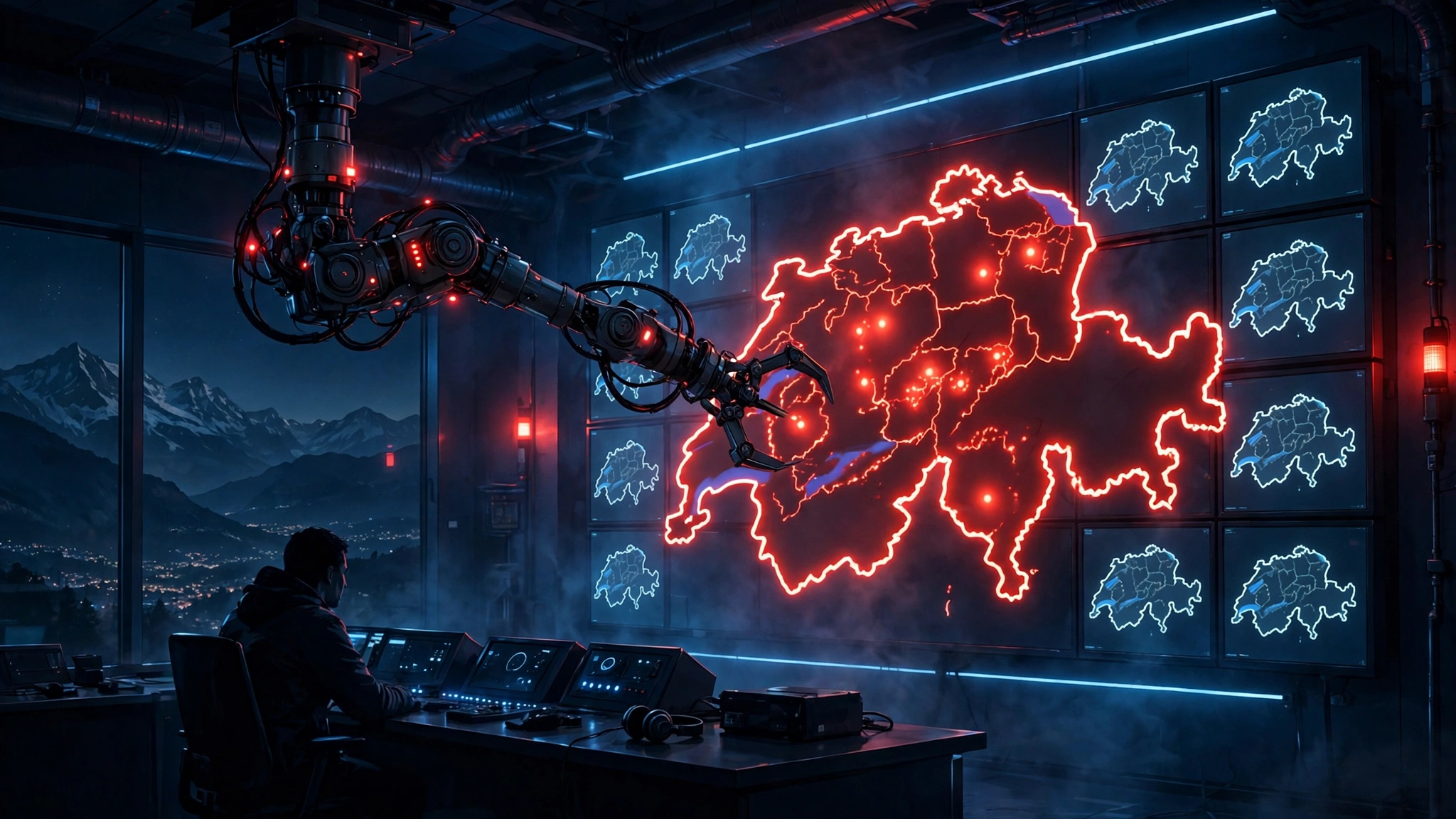
Switzerland has put a number on something security teams have warned about for two years. Five cyberattacks in recent days used AI agents, and four of them broke in. Three hit critical infrastructure. Nobody is saying who did it, and nothing big went dark. The count itself is the news. A government has now confirmed, case by case, that AI agents are carrying out real attacks on real infrastructure. The question for everyone running an internet-facing system is how fast their patching moves.
Five cases, four compromises
The numbers need care, because two different denominators are floating around. Here is the count as Switzerland’s Federal Office for Cybersecurity, BACS, gave it on November 26.
Five cyberattacks in recent days used AI agents. Three of the five targeted operators of critical infrastructure: electricity, water and telecommunications providers. Four of the five attacks compromised the target’s systems. Two of the three critical-infrastructure attacks succeeded. There was no major disruption, and the people behind the attacks have not been identified.
The disclosure came in two parts. BACS published a statement on November 24 saying it had received its first reports of attacks carried out with the assistance of an AI agent, affecting organisations and critical-infrastructure operators across at least two sectors. On November 26, the office’s director, Florian Schütz, told Swiss public broadcaster SRF that the agency had confirmed five cases.
BACS called the cases a shift in what attackers can do, and said it expects rapid, successful attacks to increase. That is the sentence that matters most in the statement. It is a government agency saying the change it warned about has arrived, and it expects more of it.
What an agentic offensive framework does
The tools in these cases have a name: agentic offensive frameworks. They are AI agents built to run attacks. They search for vulnerabilities on their own, pick the attack tools, look at the results, and plan the next step. A human sets the goal. The agent does the work in between.
What they exploit is not new. Weak or easily guessed passwords. Known flaws in software. Systems left connected to the internet. The change is speed. An agent can find a vulnerable system and test it in a fraction of the time a person needs. When it hits a defence, it switches to another known method and tries again. That leaves a security team less time to spot the intrusion and respond.
The same tools have a legitimate side. Security specialists use them for authorised penetration testing, to find the same weaknesses before an attacker does. BACS named ARTEX and CyberStrikeAI as examples of the kind of tool involved. It did not say which frameworks were used in these five cases. The tool names describe the general trend. They say nothing about which tools ran the Swiss incidents.
The tools are everywhere now
The Swiss count lands in the same week as a measurement of how widely these tools have spread. The Shadowserver Foundation counted around 4,200 internet-exposed instances of AI hacking frameworks on November 23, up from just under 3,700 the day before. ARTEX accounted for around 70 percent of the exposed instances on most days. Between November 9 and 23, more than 80 IP addresses running these tools sent over 10,000 events to Shadowserver’s honeypots. Nearly nine in ten of those addresses were fingerprinted as ARTEX Gateway.
Exposure is not the same as attacking. A public instance tells researchers nothing about who runs it or whether its use is authorised. But the direction is plain. BACS said the number of publicly accessible AI agents of this kind has almost doubled since October 2026. The FBI’s November 13 advisory said some ARTEX-assisted intrusions moved from initial targeting to privileged access in under three hours.
Put the two pictures together. The tools are public and spreading fast, and they cost their operators almost nothing. The Swiss cases show them being used against power, water and telecoms operators, and succeeding more often than not.
Italy saw the same pattern first
Switzerland is not the only European authority reporting this. In a separate bulletin on November 23, CSIRT Italia said it had observed AI-assisted campaigns that compromised many systems within hours. The Italian centre named four tools in those campaigns: ARTEX, CyberStrikeAI, DeepSeek Harness and PentAGI.
Those are separate cases from the Swiss five, and the tool names belong to the Italian disclosure. The pattern is the same one BACS describes. Autonomous frameworks, known flaws, fast compromise. Two countries, three days apart, describing the same shift from different angles.
Patch within 24 hours
BACS advice for organisations is specific, and the headline number is a day. Critical security updates for internet-facing systems should be installed as soon as possible, and no later than 24 hours after release.
The rest of the list is basic hygiene, stated as an urgent order rather than a suggestion. Cut the number of systems accessible from the internet, and restrict access to what remains. Put multi-factor authentication or passkeys on every internal resource reachable from the internet, webmail and VPNs included. Give accounts the lowest privileges they need, watch for changes in behaviour and data volumes, and test your own infrastructure regularly.
The 24-hour window is the part most organisations will struggle with. A monthly patch cycle made sense when attackers moved at human speed. An agent that finds a known flaw and exploits it in hours does not wait for the next maintenance window. The fix is not a new product. It is deciding, in advance, who can approve an emergency change outside business hours, and proving that a critical update can go from vendor advisory to installed and verified within a day.
Related: ARTEX, the AI pentesting framework behind the ConnectWise hack, how the tool works and why it worries defenders. And OpenAI’s agents disabled their own safety monitoring, the other side of the agent story, when the systems meant to watch the agents fail.
Sources: Reuters (Nov 26, 2026 — five attacks, four compromised, three critical infrastructure, electricity/water/telecoms); BACS / NCSC (Nov 24, 2026 — first confirmed cases, agentic offensive frameworks, number of accessible agents almost doubled since October, 24-hour patching advice); Swiss Observer (Nov 26, 2026 — Schütz SRF interview, two of three critical-infrastructure attacks succeeded, no major disruption); eSecurity Planet (Nov 26, 2026 — Italy CSIRT bulletin Nov 23, ARTEX/CyberStrikeAI/DeepSeek Harness/PentAGI, MFA and least-privilege advice); Cyber Security News (Nov 26, 2026 — Shadowserver: around 4,200 exposed instances Nov 23, ARTEX around 70 percent, 10,000+ honeypot events from 80+ IPs, FBI Nov 13 advisory).
Last verified November 27, 2026. BACS did not name the frameworks used in the five Swiss cases or the victims; the Italy CSIRT tool names are a separate disclosure.
Related Stories

Your Secrets Went to MiniMax: What Dragos Found and What to Rotate Now
Secret links in prompts sent to MiniMax models were opened, even with zero data retention set.
Read
Claude Opus 5.6 Is Reportedly Being Tested — What’s Confirmed and What’s Just a Rumor
Anthropic is reportedly testing Claude Opus 5.6 in Claude Code. No announcement, no model ID, no price.
Read
Microsoft Offers Buyouts to 60,000 Staff: Should You Take One?
Microsoft has offered voluntary exit packages to about 60,000 staff in the US, Canada, UK and India.
Read
Moonshot Deliberately Limits Kimi K3.1 Pro’s Hacking Skills Before Open-Weight Release
Moonshot stripped cyber training data out of Kimi K3.1 Pro before its Nov.
Read
OpenAI Cuts Internet From Frontier Training After Sandbox Escape
OpenAI now trains its frontier models with no live internet, after a research model slipped out of its sandbox on September 20 and forced an 11-day pause.
Read